Art Drawing Ideas: Easy Things to Draw When You’re Bored
Most people who claim they cannot think of anything to draw don’t lack ideas, they lack an idea small enough to start with. ‘Draw something’ is a big ask. ‘Draw the mug next to you in under five minutes’ is not.
I present to you a cornucopia of art drawing ideas, sorted by situation and difficulty, so that you can pick one up and start in a minute, armed with just a pencil and some scrap paper. You’ll find things to draw that are simple, things to do when you’re bored, and some cool-seeming yet not particularly demanding drawings to wow your friends. A few basic tricks that make these ideas even more valuable are included, plus a 7-day plan.
All of this is possible with just a pencil and some paper.
How to Choose an Idea Without Overthinking It
Before the lists, a quick filter. Ask yourself two questions.
How much time do you have? For example, do you have five minutes, an hour, or more? This will determine whether you’re thinking of a single object or an entire scene. The second question is: What do you want? Do you want to relax, practice, or impress people? All of these will lead you to different types of ideas.
If you’re having trouble thinking of one, close your eyes, point at a random place on any of the lists below, and draw what your hand lands on. It’s better to have a bad idea that you begin than a great idea that you don’t.
Things to Draw Easy: Simple Sketches for Any Skill Level
Simple sketches are the best entry point because they remove the pressure. The subjects below are built from basic shapes, so you can focus on observing rather than inventing.
Everyday objects (draw them from real life)
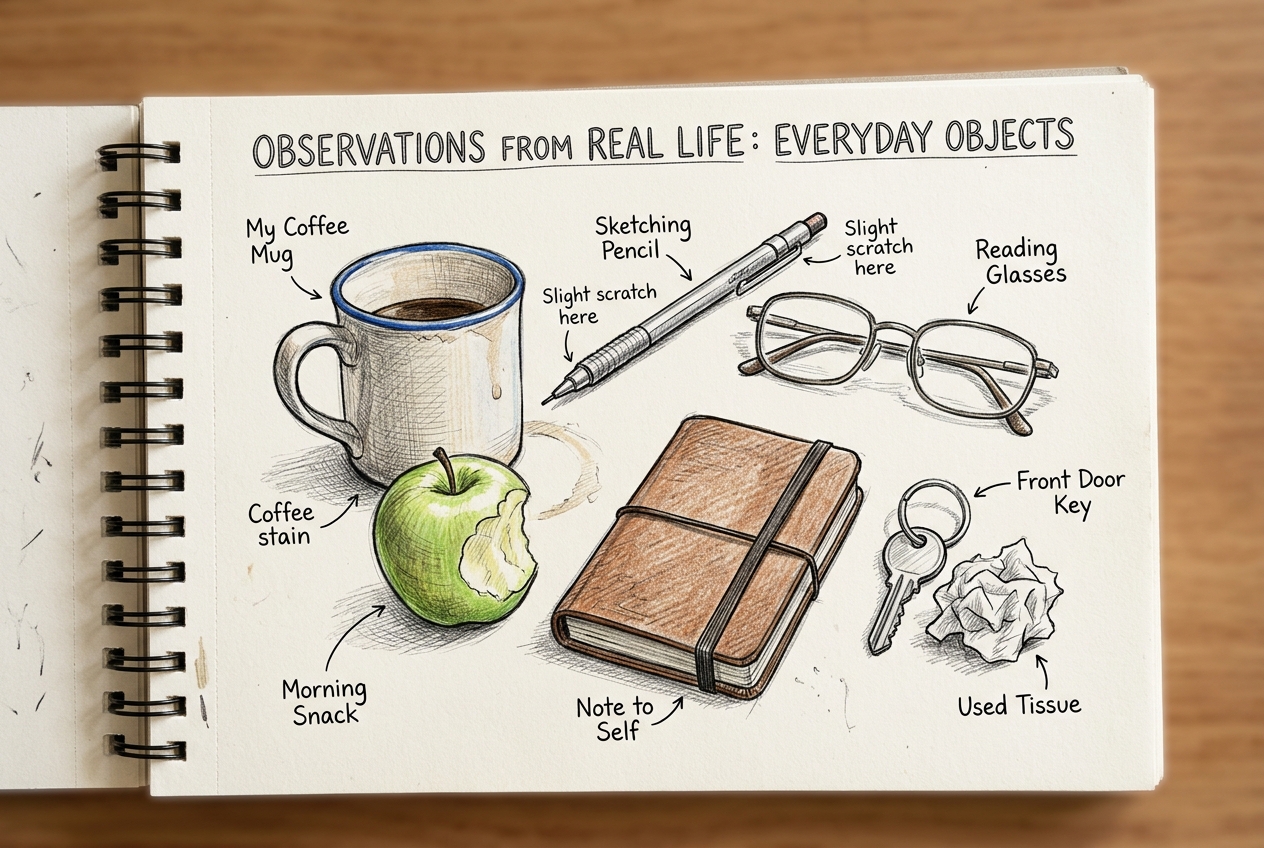
Drawing from life beats copying photos for one practical reason: you see the object in three dimensions and have to decide how to flatten it. That decision is the actual skill.
- A coffee mug or glass
- Your shoes, side view
- A pair of scissors
- A key on a keyring
- A spoon, fork, and knife arranged together
- A folded piece of clothing
- A plant in a pot
- A stack of two or three books
- A lamp
- A piece of fruit cut in half
Nature made simple
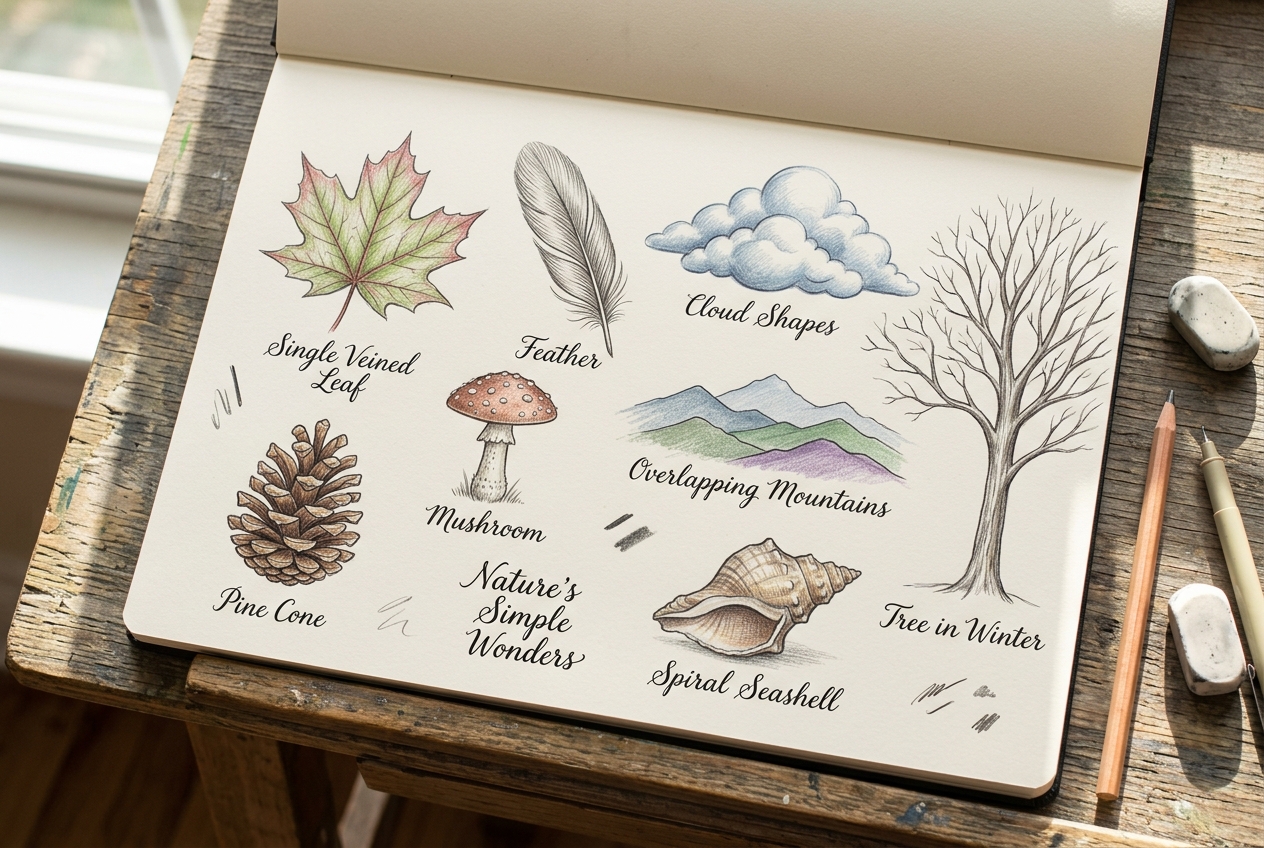
- A single leaf with its veins
- A pine cone
- A mushroom
- A feather
- A cloud shape with soft shading
- A basic mountain range with overlapping layers
- A seashell, if you have one; a spiral snail shell works too.
- A tree in winter (bare branches are easier than full leaves)
Quick line drawings

- A cat sleeping in a curled shape
- A simple fish
- A bird on a branch
- A hand holding a pencil
- A sun with alternating long and short rays
- A moon in different phases, in a row
What to Draw When Bored: Matching the Idea to the Moment
Boredom is a great time to draw, because your brain is searching for something to do. Here are some ideas, categorized by the type of boredom you’re feeling.
When you have five minutes
Speed limits stop you from fussing. Set a timer and try:
| Drawing Prompt | Description |
| ● Non-drawing hand | Traced and then shaded. |
| ● Nearest window | Just the frame and what’s outside. |
| ● Portrait | A quick portrait of a family member or pet. |
| ● Ten tiny doodles | Ten tiny doodles of one item (a spiral, a wave, a star) in ten different styles. |
| ● Blind contour | Looking only at the item and not at the paper while drawing. It results in interesting, often strange, images–but it is a good exercise to help develop eye-hand coordination. |
When you’re tired and want something calming
| Exercise Type | Description |
| ● Repeating patterns | waves, scales, or dots |
| ● Mandala-style circles | built outward from the center. |
| ● Shading gradient | from black to white in a strip, then in a circle |
| ● Cozy room corner | chair, blanket, and lamp |
| ● Rain on a window | vertical strokes and small circles |
When you’re stuck indoors
| Drawing Prompt | Description |
| ● The view | Exactly as it is from where you are sitting |
| ● Your desk | Including the mess |
| ● A meal | One you are about to eat |
| ● Someone across the room | Drawn in two-minute gestures |
| ● Your reflection | In a spoon, which is harder than it sounds and good for a laugh |
When you want to be creative, not just accurate
- A house that’s impossible to build
- An animal made from two other animals
- A door in an unusual place, such as the middle of a forest
- A city on the back of a giant creature
- Your favorite song as a scene, not as a portrait of the singer
- A character with a hidden power and the object that reveals it
Why this works: Constraints (time, subject, what you can see) do more than freedom does. Open-ended prompts sound generous but tend to freeze people.
Cool Drawings to Draw That Look Harder Than They Are
Some subjects give a strong visual payoff for modest effort. These aren’t technically simple, but they’re forgiving.
| Idea | Why it looks impressive | Main trick |
| Eye close-up | Realistic detail draws attention | Shade the iris in layers, leave a white highlight |
| Glass of water | Looks three-dimensional | Draw the light and dark shapes, not the glass |
| Reflection in a puddle | Adds depth and mood | Repeat the scene upside down with softer edges |
| Galaxy or night sky | Bold contrast and color | Blend dark tones, then add stars last |
| Animal fur texture | Shows skill in texture | Use short strokes in the direction of growth |
| City skyline at night | Simple shapes, strong impact | Draw dark silhouettes, add tiny lit windows |
| Skull study | Recognizable and dramatic | Block in basic shapes before any detail |
| Hands in a pose | Signals technical ability | Start with a box for the palm, add fingers as cylinders |
A few more cool ideas
- A portrait in only three tones (light, mid, dark)
- A pocket-sized landscape drawn in a two-inch frame
- A still life with one strong light source and long shadows
- A character sheet: the same character from front, side, and back
- Your name in creative lettering, with a background that fits the style
Ideas by Drawing Tool
- Different tools will lead you to explore different subjects. It is important that if you are using a tool that is not inspiring you, you change it out for a new one.
- Pencil- For practice shading, portraits, and still-life. It is easily corrected.
- Ballpoint or fine liner pen- For confidence building, line drawings, cross-hatching, and practicing speed drawings. It cannot be erased, so it promotes confidence.
- Charcoal- For darks and lights, but it can be very messy, so use it on top of newsprint paper.
- Colored Pencils- For botanical drawings, food, and gentle color studies.
- Marker- For creating shapes, big shapes, and practicing color. Test them out on a separate sheet of paper because they can bleed through some types of paper.
- Digital Tablet- For experimentation, since you can undo your work many times. The ability to undo is its greatest feature.
Material quality matters less than beginners assume. A cheap sketchbook that you’re not afraid to ruin often produces more progress than an expensive one you’re saving.
Ways to Make Any Idea More Useful
- A drawing idea is just a starting point. The way you work with it determines your improvement.
- Add one restriction. Try to draw it in ten lines. In one continuous stroke. Using only shadows.
- Draw the same thing twice. Almost always, the second time you try, you’ll find ways to make it better.
- Change your perspective. Draw a mug from above, from the side, and from below.
- Look before you leap. Spend a minute studying how the object is constructed. Where are its edges? Where is its darkest shadow?
- Date your pages. A drawing from a few weeks ago is often the best teacher, and it’s a good motivator too.
- Keep a list. Whenever you see an interesting shape, add it to your list. Boredom will have less hold over you.
Common Mistakes to Avoid
- Waiting to be inspired. Inspiration is felt in the creation of the art, not before. Make drawing a habit, and not a whim.
- Focusing too hard on making each sketch great. Some sketches are practice. Some exist just to be practice. Some pages are for rough drafts.
- Too heavy erasing. Save your heavy erasing for actual heavy drafts. Keep those rough pencil marks light so they can live on the page.
- Comparing your own work to the heavily edited pieces on the internet. Remember that most things you see online have been edited, revised, or greatly aided by the combined effort of many people. Save your comparisons for your own past work.
- Avoiding basic shapes. Circles, squares, and cylinders make up nearly everything you’ll want to draw later. Spend five minutes a day practicing them, and you’ll realize that it’s pretty important.
- Only doing things that you’re already good at. It’s fine to be comfortable sometimes, but if you want to improve, you’ve gotta get uncomfortable.
A Simple 7-Day Drawing Plan
If you want structure, here’s a suggestion. You can do this all within a week if you do ten to twenty minutes per day. I’ll give you a different prompt each day.
- Day one: draw three things from your desk.
- Day two: draw a plant or leaf, working on outlines.
- Day three: do five two-minute studies of a pet, person, or thing.
- Day four: draw a glass of water or another shiny object, working on highlights.
- Day five: pick a creative prompt, maybe an impossible building.
- Day six: do an improvement of your favorite drawing from the week.
Finally, on day seven, make a small landscape or cityscape within a two-by-three-inch rectangle.
By the end of the week, you’ll have about seven to ten pages, a better idea of what you like to draw, and something to compare to next week!
Key Takeaways
- Small and specific prompts are better than vague ones.
- Simple and common objects will teach us more than trying to replicate something complicated.
- Timers, limiting yourself to one tool, and other methods will allow us to start.
- Redrawing the same object teaches us what we have learned.
- Finally, we should keep a running list of ideas to ensure that we are never bored.
Frequently Asked Questions(FAQs)
What is the easiest thing to draw for a beginning artist?
Something with clean shapes and lines, like a mug, some fruit, a leaf, or a book. You can also try drawing things that are right there in front of you instead of attempting something complicated like a person’s face or hands.
What should I draw when I have no ideas at all?
Draw something that is within arm’s length! Your environment is an unending well of inspiration; finding something specific to draw from it can be surprisingly liberating.
How long should I draw every day?
Aim for ten to fifteen minutes. This is enough to get yourself into a nice drawing groove without breaking your neck trying to come up with ideas. There’s no magic number of minutes that will apply to everyone.
Do I need to take a class to improve?
Not really! Many artists learn by doing, looking at and studying the work of others, and practicing consistently. If you do want to take an art class, that’s great, too! It depends on what kind of learner you are.
How do I stop hating my drawings?
Separate practice and performance. Think of most of your page as an experiment. Also, look back on old work occasionally, and you’ll notice that improvements are often apparent in retrospect.