55+ Doodle Art Ideas to Spark Your Creativity
Most people would not have a problem with doodling. They have a problem with getting started. A blank page feels like a demand for something good, which puts pressure on even a pencil and five free minutes.
Doodling is good because it puts less pressure. It is a small, unplanned drawing, which makes it perfect for building a habit of drawing. It can be done anywhere, and it is impossible to fail at.
This guide contains over 60 doodle art ideas divided into themes for easy access. This means you can simply pick a category and start drawing right away. After the lists of doodle ideas, you can find helpful advice on how to make your doodles look nice, common mistakes, and how to create a doodling habit for a week.
What Counts as Doodle Art?
Doodle art drawing sits between random scribbling and finished illustration. It usually has these traits:
- Simple, often outlined shapes.
- Playful or exaggerated proportions
- Repeated elements like dots, lines, and patterns
- Little or no perspective or realistic shading
Some people keep doodles in the margins of notebooks. Others build full pages, sometimes called doodle spreads, with dozens of small drawings packed together. Both are valid. The ideas below work for either.
What You Need to Start
You need less than you think.
- A fine-tip pen or pencil. A pen with a consistent line, such as a 0.3 to 0.5 mm fineliner, gives clean results. If you’re nervous about mistakes, start with pencil.
- Any paper. Printer paper, a cheap notebook, or a sketchbook all work. Thin paper can show ink through the back, so check before you fill a whole page.
- Optional color. Markers, colored pencils, or a single accent color can lift a plain black-and-white doodle. Try one color before you try ten.
If you plan to use markers, test them on a scrap corner first. Some bleed through thin paper, and it’s better to find out early.
Simple Doodle Art Ideas for Beginners

These are the fastest doodles to draw. They rely on basic shapes, so they are ideal warm-ups and great for filling gaps on a page.
- Spirals. Draw one tight, one loose, and one that squares off at the corners.
- Stars. Try a five-point star, a four-point sparkle, and a star made of crossing lines.
- Hearts. Vary the size, then add stripes, dots, or a tiny pattern inside.
- Arrows. Curved, looping, and broken arrows all look good scattered around a page.
- Wavy and zigzag lines. Stack three of them in a row to make a quick decorative band.
- Clouds. Start with three bumps on top and a flat bottom, then add a second layer behind.
- Lightning bolts.Sharp, angular shapes give contrast next to soft clouds and hearts.
- Crowns. A zigzag top with small circles on each point is enough.
- Banners and ribbons. These frame words and are useful later for lettering.
- Flags on poles.Change the flag shape and add patterns to make each one different.
A useful habit: draw each shape three ways before moving on. Your second and third attempts are often more interesting than your first, because you stop trying to draw “the correct version.”
Cute and Easy Doodles
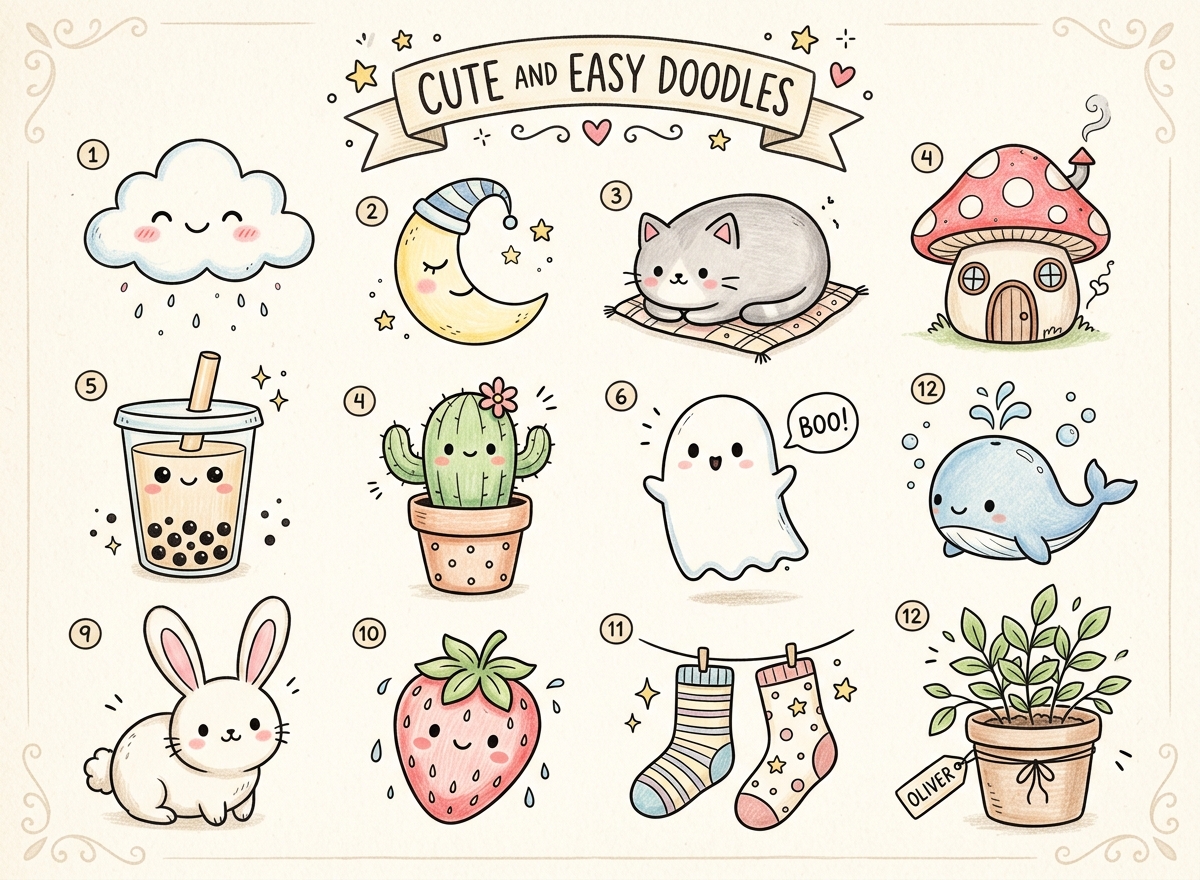
Cute doodles tend to follow a few consistent rules. Round shapes, small limbs, and simple faces with wide-set eyes and a tiny mouth all push a drawing toward “cute.” Once you notice this, you can apply it to almost anything.
- A smiling cloud with blushing cheeks.
- A sleepy crescent moon with closed eyes and a small nightcap.
- A cat loaf. Draw an oval body, add two triangle ears, and skip the legs entirely.
- A mushroom house with a tiny door and round windows.
- A boba tea cup with a face, a wide straw, and dots at the bottom.
- A cactus in a pot, with a small flower on top.
- A ghost with a wavy hem and two dot eyes.
- A tiny whale with a curved water spout.
- A bunny, using two long ears and a round body.
- A strawberry with a face, with seeds drawn as small teardrops.
- A mismatched pair of socks, each with a different pattern.
- A potted plant with a name tag, which adds a small storytelling detail.
If your characters look stiff, change the eye placement. Moving the eyes lower on the face makes most characters look younger and softer. It’s a small change with a big effect.
Nature Doodles

Nature gives you endless shapes, and irregularity is welcome. A crooked leaf looks natural, not wrong.
- Leaf branches. Draw a curved stem, then add leaves in pairs or alternating along it.
- Wildflowers. Use simple petals, and vary the centers with dots, stripes, or spirals.
- Mountain Overlap triangles, with small snow caps on the tallest peaks.
- Ocean waves. Repeated curling lines work well as a border.
- Sun rays. Alternate straight and wavy rays around a circle.
- Raindrops. Vary their size and add a small puddle ripple.
- Seashells. Fan shapes and spirals are easy starting points.
- Feathers. One central line with short, angled strokes on both sides.
- Tree rings. Concentric wobbly circles make a nice pattern filler.
- Ferns. Long, curved fronds with small leaflets, getting smaller toward the tip.
Food and Drink Doodles
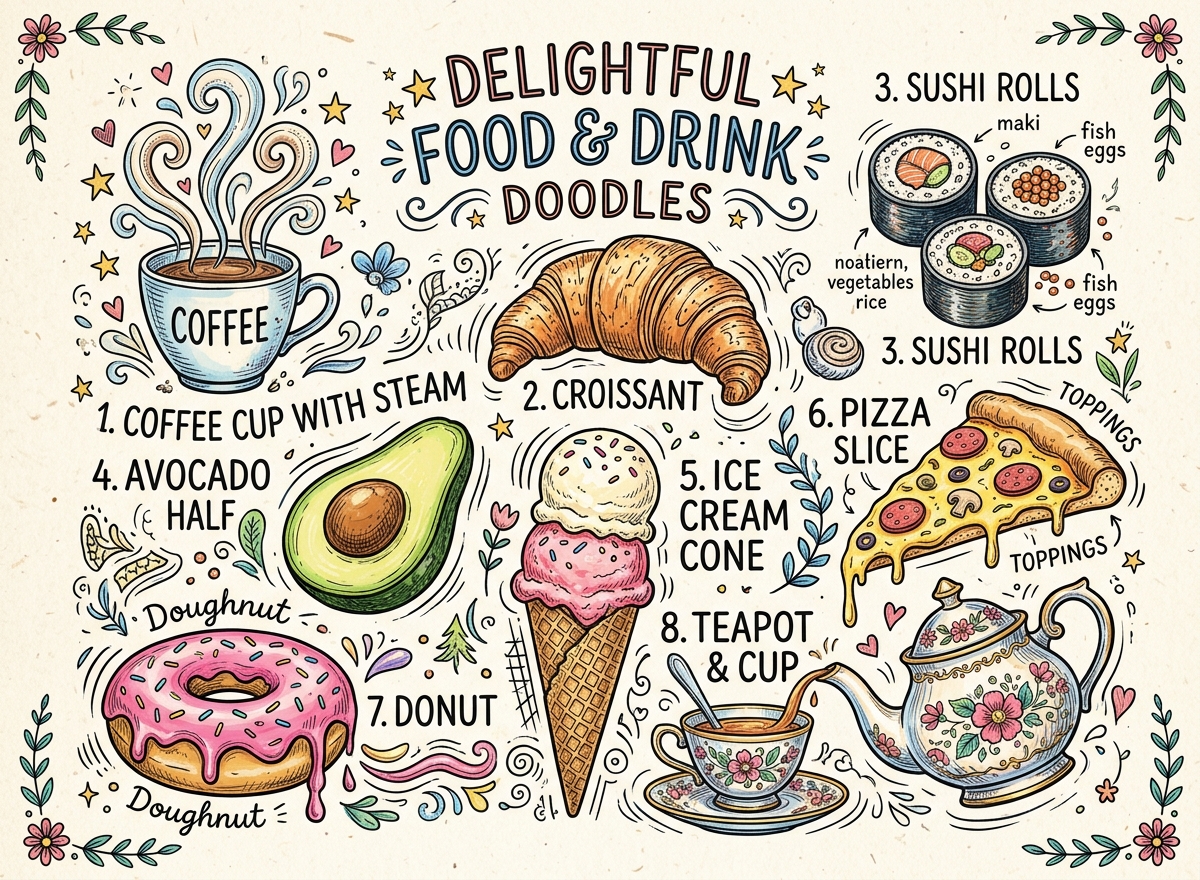
Food is popular for a reason. Everyone recognizes it, and the shapes are forgiving.
- A coffee cupwith steam curling upward.
- A croissant, built from curved segments.
- Sushi rollsas circles with small inner details.
- An avocadohalf with a large round pit.
- An ice cream cone,with a waffle pattern crosshatched on the cone.
- A pizza slicewith a drooping tip and a few toppings.
- A donutwith icing drips and sprinkles.
- A teapot, paired with a cup and saucer.
Everyday Object Doodles
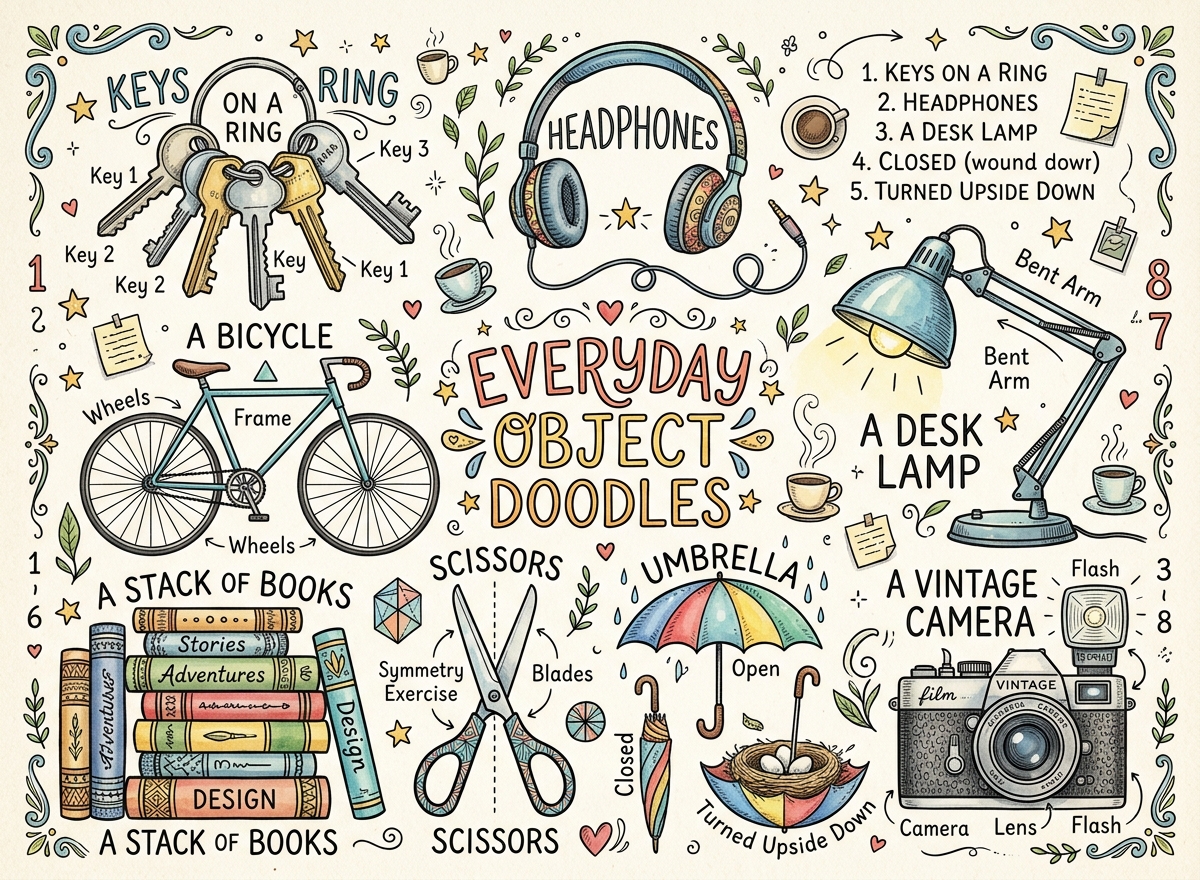
Objects around you are handy references. You don’t need a photo. Just look at what’s on your desk.
- A set of keys on a ring,each with a different tooth pattern.
- Headphones, which are basically a curve and two rounded shapes.
- A bicycle, using two circles and simple triangle geometry.
- A desk lampwith a bent arm.
- A stack of books with different spine designs.
- An umbrella, open, closed, or turned upside down.
- Scissors, which are a good exercise in symmetry.
- A vintage camera, with a round lens and a small flash.
Patterns and Abstract Doodles
Pattern doodles are calming to draw. They also make excellent fillers around larger drawings.
- Checkerboards with wobbly squares.
- Scale patterns,made of overlapping semicircles.
- Dot gradients, where dots slowly grow from small to large.
- Woven lines, with lines passing over and under each other.
- Bubbles, with small highlight marks in each.
- Geometric grids with a different pattern in each cell.
- Contour lines, like a topographic map that repeats an outline inward.
- Radiating shapes, built outward from a small central circle.
If you like structured pattern drawing, the Zentangle method is a well-known approach that uses repeated patterns in small sections. Check the official Zentangle website for its current guidance and terminology.
Lettering and Border Doodles
Words plus doodles create pages that feel finished.
- Bubble letters, with small highlight strokes.
- A framed word,surrounded by tiny stars or leaves.
- Corner flourishesfor the edges of a page.
- Your name, with each letter given a different pattern.
- Divider lines, such as dashes with small diamonds in the middle.
- A quote in a banner, using the banner shapes from earlier.
Prompt-Style Doodle Ideas When You Want Meaning, Not Just Shapes
Sometimes you want a doodle to say something. These prompts lean on stories and moods:
- Draw what you ate today, one item per small square.
- Draw five things in your bag.
- Doodle the weather outside as a small character.
- Draw an object with a face and give it a problem.
- Fill a page using only circles.
- Turn a single line into a creature.
- Draw your mood as a plant.
These give your doodles a purpose, which helps if pure shape-drawing starts to feel empty.
How to Make Simple Doodles Look More Polished
You don’t need advanced skills to improve. A few habits go a long way.
- Add depth with overlap. Draw one shape partly in front of another, and erase or skip the hidden lines. This makes a page look layered.
- Use line variety. Thicker outlines and thinner inside details give a doodle structure. Even one pen with slightly heavier pressure on outer edges helps.
- Repeat elements. Three small stars near one big star look planned. Repetition ties a page together.
- Leave breathing room. A crowded page can feel noisy. White space makes the busy parts stand out.
- Limit your palette. Two or three colors usually look more cohesive than a full rainbow.
- Add tiny details last. Dots, dashes, and small sparkles fill gaps and add finish.
Common Doodling Mistakes to Avoid
- Erasing too much. Wobbly lines are part of the style. Constant erasing removes that charm and slows you down.
- Copying too closely. Reference is useful, but try changing at least one thing, such as the proportions or the pattern, so the result feels like yours.
- Filling every gap immediately. Pause and look at the page before adding more.
- Judging early. Many doodles look odd halfway through. Finish before you decide.
- Using pens that smudge. If your hand drags across the page, choose a quick-dry pen or work from the opposite side.
- Waiting for inspiration. Draw a spiral, a star, or a wavy line to start. Momentum tends to bring ideas.
A Simple One-Week Doodle Plan
This is a suggested routine, not a rule. Ten minutes a day is enough.
| Day | Theme | Try |
| 1 | Shapes | Ten spirals and stars |
| 2 | Cute characters | A cloud, a ghost, a bunny |
| 3 | Nature | A leaf branch and a wave border |
| 4 | Food | A coffee cup and a donut |
| 5 | Objects | Three items from your desk |
| 6 | Patterns | One page of pattern fillers |
| 7 | Combine | A full page mixing your favorites |
By the end, you’ll likely notice which subjects you enjoy most, and that is the start of a personal style.
Final Thoughts
You don’t need to think of brilliant doodle art ideas to start doodling. Just pick something off of this list, draw it three ways, and add a little detail of your very own invention. That’s doodle art!
Frequently Asked Questions(FAQs)
Do I have to be good at drawing to doodle?
No, doodling is all about having fun and using simple shapes so that anyone can give it a try.
What are the best things to doodle as a beginner?
Spirals, stars, clouds, leaves, and simple foods are all great subjects for someone just starting with doodling.
How long should I spend doodling?
It can be as long as a few minutes to an hour or two; really, it’s up to you and how much time you want to spend doodling. The whole page could take a while because you have so many little doodles to fill in.
How do I find my doodling style?
Look at which subjects you seem to like and keep practicing them, making slight alterations to each one. The more you doodle, the more of your style will come out in your doodles.
Does doodling have any therapeutic benefits?
Many people enjoy doing it and think it helps them unwind. It is also nice to take a break from screens and do something relaxing. Don’t believe me? Do your own research and look up the benefits of doodling.
How do I make my doodles not look so childish?
Nothing is wrong with childlike art! However, if you want to make your doodles look less childish, practice using the same line thickness and use patterns to make your doodles look more sophisticated.