50+ Creative Pop Art Ideas to Try for Fun and Inspiration
Pop art has a certain staying power. Long after its peak as an art movement, it persists in modern culture. From tote bags to dorm room posters, magazines to Instagram, pop art surrounds us. Partly because it is accessible, it doesn’t demand technical skill or painterly precision, but also because it asks the artist to engage with their world and reflect it in bright colors, repeated images, and a touch of irony.
If you’ve browsed the web for pop art inspiration, chances are you’ve stumbled upon the same five Andy Warhol pieces over and over. This guide includes the pop art greats for reference, but also goes deeper, offering an in-depth look at the characteristics that define the style, as well as more than 50 creative pop art ideas for your own pop art project, organized by medium and approach.
What Makes Something “Pop Art,” Really?
Beforehand jumping into brainstorming, it is essential to distinguish between various forms of artistic expression. The pop art movement was developed by British artists in the mid-1950s and later experienced its peak in the United States in the 1960s. This movement’s primary philosophical concept revolves around the idea that consumer culture, advertisements, comics, and movie stars are valid subjects for fine art.
Several characteristics are typically attributed to works of pop art:
- The use of bright colors in large color blocks as opposed to subtle blending;
- The frequent use of contrasting colors with black outlines;
- The repetition of the same motif in a grid manner with color variations;
- Depiction of commonplace objects and characters;
- The use of halftone dots to simulate newsprint texture;
- Commentary on popular subjects and the deliberate juxtaposition of high art with low art.
Though not all of the characteristics may be present in a work of pop art, the presence of some of them would suffice to convey its essence.
Well-Known Pop Art Examples Worth Studying
If you want to shape your creative ideas, you need to study these people closely and look at all the unique aspects that made them iconic in pop art history. Here are some of the central ideas and styles that pop artists used:
- Andy Warhol is the most recognizable figure in the history of pop art. He mostly used repeating silkscreen prints to make his portraits (Marilyn Monroe, Elvis Presley) and comic murals (Campbell’s Soup Cans).
- Roy Lichtenstein drew inspiration from comics’ colorful lines and simple graphics and turned them into his vivid paintings using Ben-Day dots.
- Graffiti-style doodles and cartoon-like figures with lots of white space were the hallmark of Keith Haring’s work. This artist drew attention to his figures’ simplicity and uniqueness.
- James Rosenquist was a billboard painter by trade and remained faithful to the language of billboards in his art. His art was essentially a collection of icons and images from advertising.
- Huge sculptures made from junk and found objects were the specialty of Claes Oldenburg, who also took pop art toward three-dimensionality.
All these characteristics can be used as inspiration for creating your own masterpieces. However, do not copy other artists’ works, as they are often under copyright. Use their techniques (think of repetition, flatness, and color saturation), graphic tools, and subjects (everyday items and icons).
Pop Art Ideas for Painting and Drawing

These are great prompts to practice working with canvas, paper, or a tablet.
- Self Portraitin 4 color variations (Warhol style: using complementary colors in a square grid)
- Pet Portrait using halftone dots to suggest fur rather than painting it all in detail.
- Everyday snack packaging redesigned as a flat-color painting.
- Comic Panel using thick outlines and speech bubbles to depict a scene from your life
- Retro Appliances: Painting of an old toaster, radio, or telephone in bright colors
- Fruit or Vegetablepainted in exaggerated colors
- Shoes or Sneakers in 4 color variations (one shoe)
- Contour Portraitwith patterned background instead of a solid color
- Emoji as a Lichtenstein-style painting of a character
- Vintage Advertisement:Using an old ad design but depicting your own product
- Musical instrumentdrawn in primary colors and outlined in black.
- City Skylineusing only 3 flat colors.
- Flowers still life using Ben-Day dots.
- Cartoon Weather:raindrops, lightning, clouds, etc. rendered like comic panels
- ‘Self Portrait with thought bubble’, a pop culture phrase as a thought bubble on your own face like in a comic book.
Pop Art Ideas for Crafts and DIY Projects
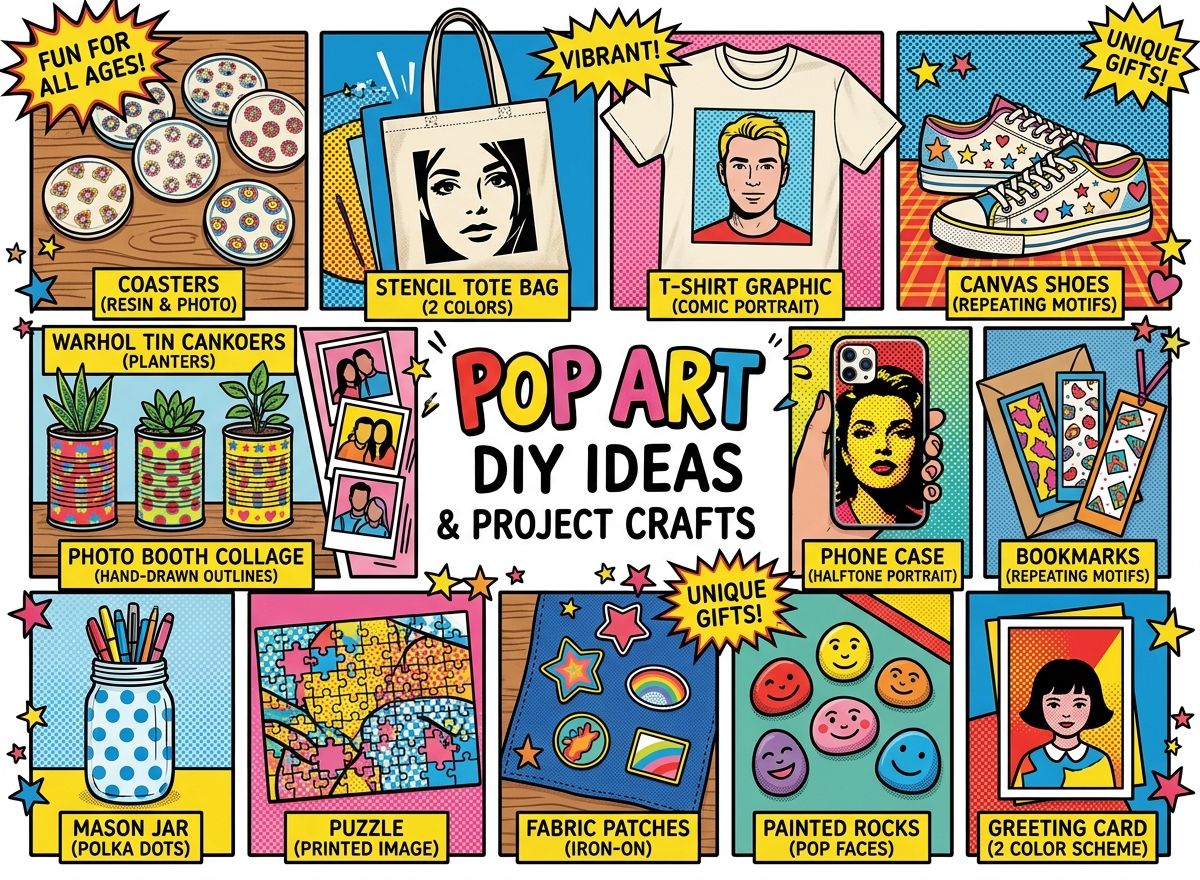
Pop art lends itself really well to hands-on projects, which is great for novices or in a classroom setting.
- Pop art coastersmade of printed photos sealed with resin or laminate.
- Tote bag stencil projectwith one graphic and two colors
- T-shirt graphic using a simplified comic book-style portrait
- Painted canvasshoes with a small motif repeated several times.
- Recycled tin canspainted in the style of Warhol with repeated patterns used as planters
- Photo booth strip collage with printed photos outlined in markers to give them a hand-drawn look
- Phone case designfeaturing a halftone portrait
- Pop art bookmarkswith small motifs repeated multiple times on cardstock.
- Mason jar pencil holders with large painted stripes or polka dots
- DIY pop art puzzle with a printed image cut into a jigsaw puzzle, then put back together as a gift
- Fabric patcheswith painted designs that can be ironed onto clothing or bags
- Painted rockswith simple pop art-style faces or motifs
- Greeting cardswith one prominent subject and a two-color scheme
Pop Art Graphic Design Ideas (Digital)
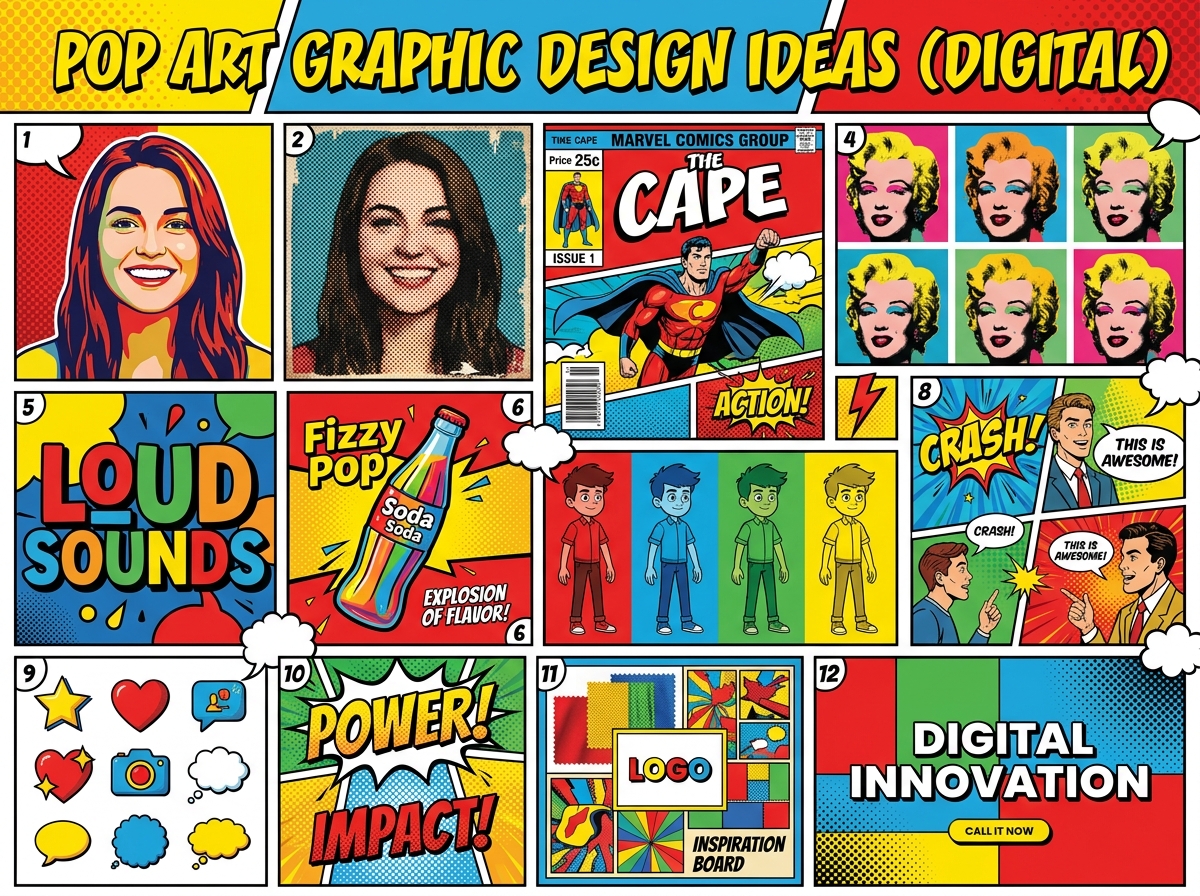
If you work in Photoshop, Procreate, Illustrator, or Canva, pop art translates naturally to digital tools. This is where “pop art graphic design” really comes into play, since most modern pop-art-inspired work you see online (band posters, product mockups, social graphics) is created digitally rather than painted by hand.
- Photo-to-pop-art filter effect:convert a photo into flat color blocks using threshold and posterize tools
- Halftone pattern overlayon a portrait using a dot-screen filter
- Comic book cover mockupfor a fictional superhero based on a real photo
- Social media carouselusing repeated grid-style portraits (a nod to Warhol’s Marilyn series)
- Album cover conceptusing bold typography and a single flat-color image
- Product mockup poster:take a real product photo and redesign the packaging in pop art style
- Animated GIFcycling through four color variations of the same image
- Vector-based comic panelbuilt entirely in Illustrator with speech bubbles.
- Instagram highlight coversusing a unified pop art color palette.
- Typography posterusing a single bold word in comic-style lettering with dot shading
- Brand mood boardexploring how pop art aesthetics could apply to a fictional product line.
- Website hero bannerusing flat color blocks and a halftone image treatment
Pop Art Ideas for Home Decor
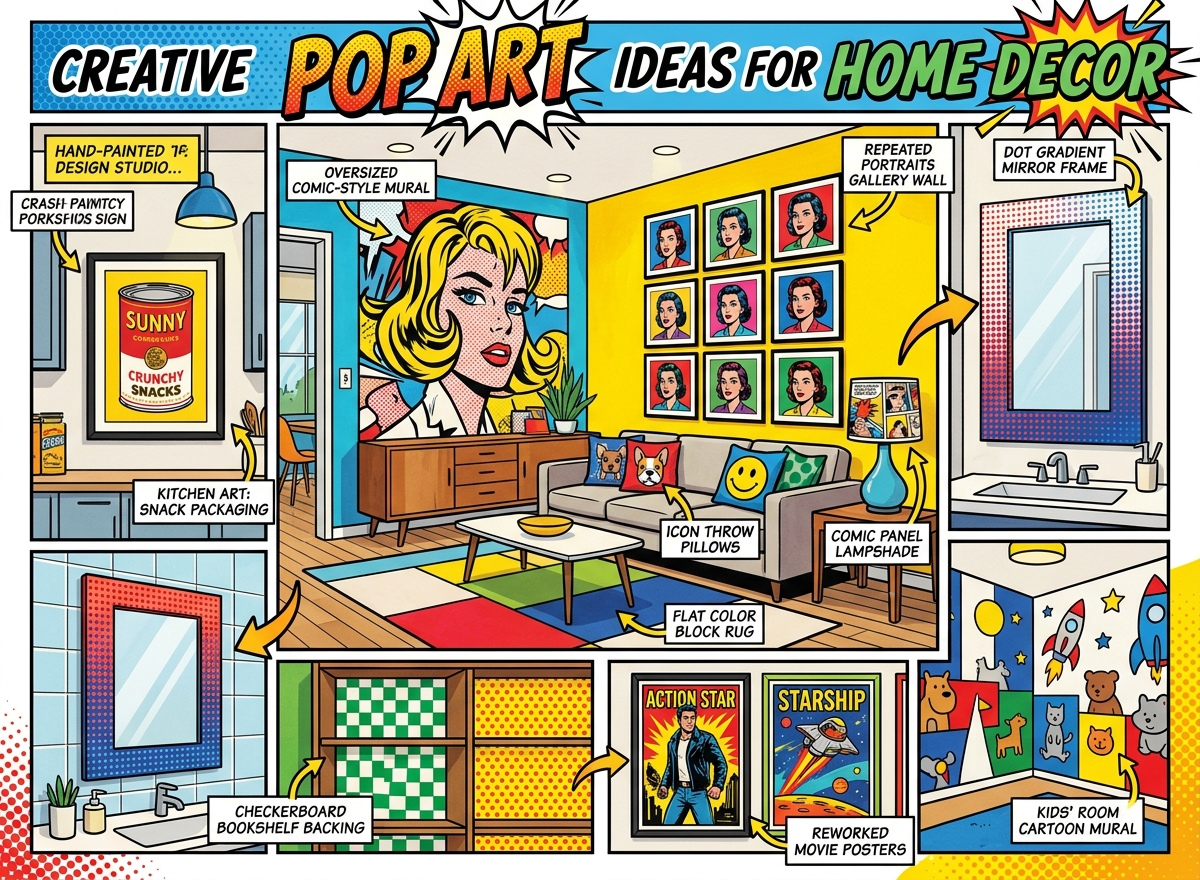
Pop art is a natural fit for interiors because it’s meant to be bold and a little loud.
- Gallery wall of repeated portraitsin different color schemes, framed uniformly
- Accent wall with a single oversized pop art mural, even a simple geometric or comic-style design
- Pop art throw pillowswith a repeated icon or face
- Custom lampshadewith a printed comic panel
- Kitchen art featuring food packaging, a nod to the Campbell’s Soup Cans concept, using your own favorite snack instead
- Bathroom mirror framedecorated with small painted dots in a gradient pattern
- Bookshelf backingpainted in a bold checkerboard or dot pattern.
- Statement rugwith large flat color blocks
- Framed record covers, or movie postersreworked in pop art color schemes.
- Kids’ room muralusing simple cartoon shapes and primary colors
Bonus Ideas Across Categories
- Pop art wedding or event invitationsusing a couple’s photo in halftone style
- Pop art business cardsfor a creative freelancer or small business
- Nail artwith tiny dot patterns and bold color blocking
- Cake decoratingusing fondant in flat pop-art color panels
- Skateboard deck designwith a comic-style graphic
How to Choose the Right Pop Art Idea for Your Skill Level
Not every idea on this list requires the same time, tools, or experience. A rough way to think about it:
| Skill Level | Good Starting Ideas | Why |
| Beginner | Painted coasters, stenciled tote bags, single-subject portraits | Low material cost, forgiving of mistakes, quick to finish |
| Intermediate | Comic panel paintings, halftone digital portraits, gallery wall grids | Require some planning around color and composition |
| Advanced | Large-scale murals, vector-based comic covers, multi-panel repeated series | Demand precision with layout, scale, and color consistency |
If you’re new to pop art, resist the urge to jump straight into a Warhol-style four-panel grid. Start with one strong image and one bold color decision. You can always add repetition and complexity once you’re comfortable with flat color blocking and clean outlines.
Common Mistakes to Avoid
- Using too many colors in the process. Pop art is not about multiple colors, unless they are being applied as a flat surface. The two to four colors per artwork rule is a good example of a pop art creation.
- Using blended or shaded colors. Gradients and shadows are the complete opposite of the pop art style, as it goes against the simple and straight-to-the-point nature of pieces.
- Not outlining the image. Pop art almost always has thick black outlines that give the piece its distinct look. Leaving this step out will make the artwork almost unrecognizable.
- Using copyrighted images and logos for public display. It is best to avoid anything that requires copyright when making art for others to see. It is okay to draw something like Marvel characters or the Coca-Cola logo as self-practice, but it cannot be displayed publicly.
- Making the composition overly complex. Pop art is supposed to click immediately; if it takes longer than a second to guess what the piece is supposed to represent, it is better to go simpler.
Final Thoughts
The appeal of the pop art ideas is that they are accessible to everybody. You can spend your afternoon creating a coaster with a two-color design or invest weeks of your life into a digital multi-panel. Either way, the principles of pop art remain the same. You need to conceptualize a subject matter that people can recognize, utilize flat color schemes, make a statement with outlines, and most importantly, embrace repetition.
Frequently Asked Questions
Is pop art something that is easily learned or understood by beginners? Is it easier than photorealistic painting?
Since it uses flat color, heavy outlines, and doesn’t call for blending and detailing, pop art is one of the easiest styles to learn for a beginner.
Would a person have to be an expert drawer to do pop art?
Not necessarily. A lot of pop art is based on a trace or posterized photo or a photo-manipulated image, not hand-drawn.
How is pop art different from comic book art?
While some comic book styles are incorporated, especially in the works of Lichtenstein, pop art is a much broader term that includes things like commercial product art, portraits, and other various media that are more than just illustrations.
Wouldn’t you say that pop art is minimalist?
It can be, yes. While many artists incorporate a lot of things into one piece, some of the best examples of pop art use only one subject with two colors. It doesn’t have to be busy; it just has to be bold.