The Mystery of Chacmool: Exploring Ancient Mesoamerican Art
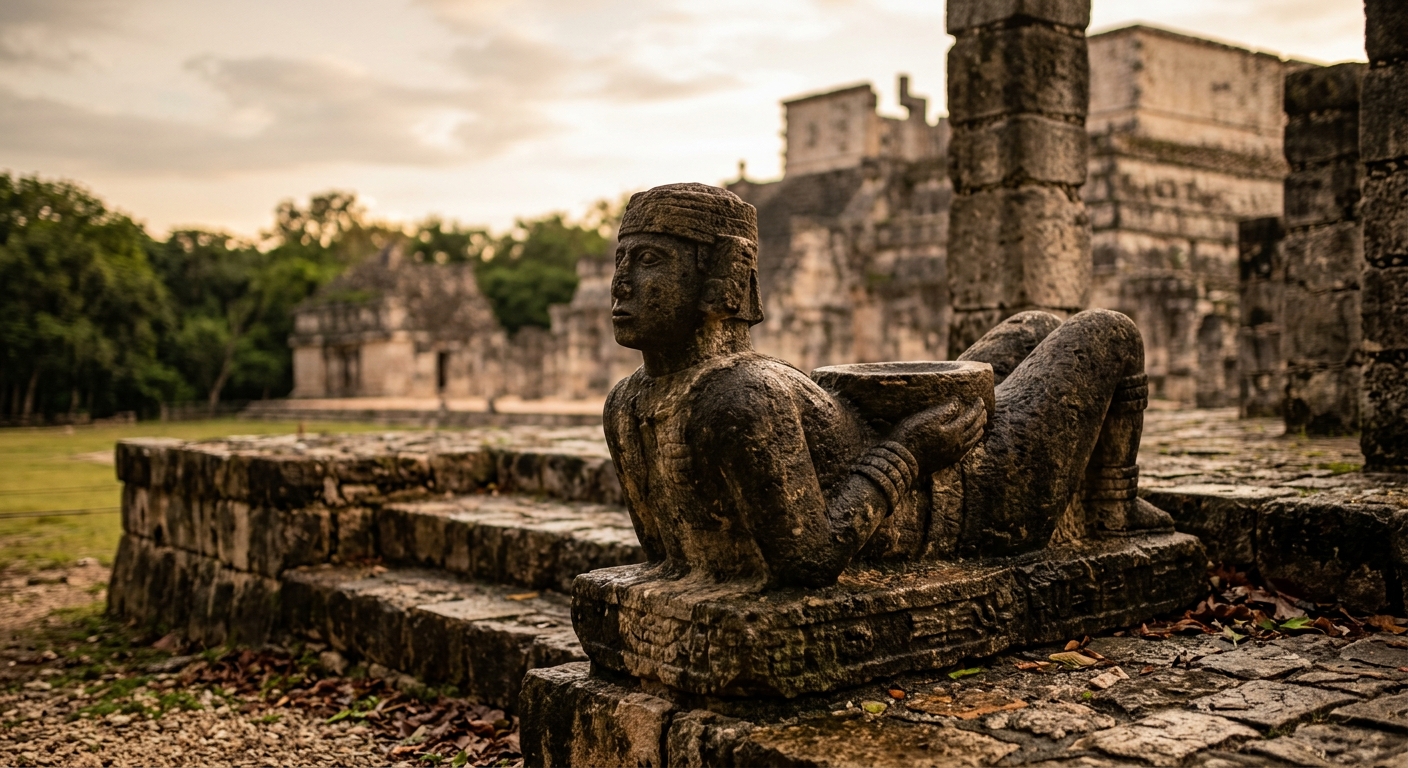
Imagine a stone figure lying on its back, knees drawn up, head sharply turned to one side; it wears a flat dish or bowl on its breast. The figure rests but stays alert, as if waiting for something to happen.
That’s a chacmool (or each mool). Visitors to Mexican museums and archaeological sites are likely to leave with a stronger impression of it than nearly anything else, and with similar questions: what was its purpose, who made it, and why does it look the way it does?
This guide answers those questions, addresses a few misconceptions, and tells you where to see the most impressive examples.
What Is a Chacmool?
A chacmool is a stone figure made by prehistoric Mesoamerican people. Virtually all of them possess the same basic pose:
- The figure is lying on its back.
- Its knees are bent vertically, and the feet are placed flat;
- The head is turned almost 90 degrees to one side, looking sideways, not upwards,
- and the hands, often crossed, hold a bowl, plate, or disk upon the stomach.
Stone figures, often wearing earflaps and other signs of the elite, and sometimes bearing headdresses, sandals, and other clothing, are generally life-sized or close to life-sized, giving the impression of a massive physical presence.
A chacmool is not a particular god or ruler, but a class of sculptures: several related styles have been discovered dating from different civilizations.
Read More: 60+ Modern Nail Art Ideas for a Stylish Look
A Name That Was Never Ancient
The first surprise is that none of the ancient Mesoamerican peoples seem to have referred to these statues as “chacmool.”
The word comes down to us from a 19th-century excavator, Augustus Le Plongeon, who dug up a recumbent figure from Chichen Itza (Yucatan) in 1875 and decided to call it by the name of Chaacmol, a purported Maya ruler. Subsequent researchers have dismissed this as wishful thinking, but the name has retained currency, if only because it was already in circulation when further excavations could verify or refute it.
So when you come across the term “chacmool,” remember that it is more or less a modern invention, like “Venus” in classical archaeology-only it tells you less about what the objects actually were to their contemporaries than about modern trends in Mesoamericanist scholarship.
Same goes for any purported “etymology” of the word, of course.
What Was It For? What We Know and What We Don’t
It’s hard to say for sure, but there is evidence pointing to one direction.
The bowl is the giveaway; the dish on the belly suggests that it was used as a receptacle. Most commonly, it would be offerings. Depending on the site and period, it could have contained food, incense, valuable items, or even something used in sacrifice. Heart offerings have been shown in popular media and even in exhibits, as well as by tour guides, but it is very likely to have happened in Aztec culture, though it is still an assumption for this specific chacmool.
Location is another big hint; these statues were commonly placed in important places, tops of staircases leading to temples, inside or in front of temples, and even shrines, basically acting as an intermediary.
The pose almost suggests service; a resting body with an almost turned head is not a usual position for something that is meant to be observed from the front. It looks more like an assistant watching, receiving, or even giving.
One simple way to sum it up, the chacmool is most likely not a sculpture, but a piece of furniture used for religious offerings.
Where Did the Chacmool Come From?
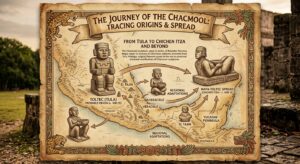
The chacmool is predominantly linked with the Early Postclassic period (tenth to twelfth centuries CE), yet examples of this attribute also survived in later times. It is connected with the Toltec realm of central Mexico and the city of Chichen Itza, which demonstrates features typical of that tradition.
Two centres, representing distinct cultural traditions, occupy a place of honour in the controversy:
- Tula in the state of Hidalgo, linked with Toltec culture.
- Chichen Itza in Yucatan, a Maya city notable for its substantial central Mexican influence on its art and architecture.
The issue of priority and the nature of the relationships between the two has been the subject of controversy for decades, and scholars have not reached a firm consensus. Chronological analyses of the two centres have undergone revision as more accurate dating methods have become available. Consequently, it should be noted that the phrasing of any particular argument depends on the time at which it was made and who made it.
What is evident is that the form had wide distribution. Chacmools have been discovered in distinct cultural regions in Mexico, including the Valley of Mexico and Michoacan, and they also survived in Aztec Tenochtitlan long after the period associated with Tula and Chichen Itza as centres of power had passed away. This demonstrates that the attribute was considered to be worthwhile in more than one cultural tradition and had been adopted by different peoples.
Chacmool at Chichen Itza
For most tourists, the phrase chacmool Chichen Itza is associated with the following information, so we offer you this list of findings:
Temple of the Warriors – a chacmool is located on the terrace at the top of the stairs leading to the temple. Such finds of sculptures were discovered exactly in the place where the offering could be expected, since the stone figure is located above the niches with warrior masks. This architectural detail makes the find even more notable and valuable.
Inside the Castillo (Temple of Kukulkan). Within the ancient pyramid, an earlier temple was found, which was walled off and sealed for visitors. Despite this, inside the Castillo, a chacmool with a red jaguar throne was found. This find directly connects the sculpture with the sacred building and the endowment for which it was intended. The inner chamber of the pyramid is considered inaccessible, so the availability of the sculpture may change over time – it is essential to research before visiting.
Le Plongeon’s discovery: the figure of the sculpture, which received its name, was found in Chichen Itza and presented to the Mexican capital’s museum. Subsequently, such an interesting exhibit for Mexican archaeology was highly in demand, which indirectly explains the presence of various copies of the sculpture in different collections. However, although it seems strange at first glance, this is the standard procedure for exhibiting ancient finds. In this way, two exhibits can bring the visitor more comfort and serve for better understanding: both in the museum and at the archaeological site.
Chacmools Beyond the Maya Area
Chichen Itza is more famous than Tula, but for understanding the chacmool, one should prefer the national museums.
Firstly, Tula, Hidalgo, is a place where one can see how the chacmool statues fit into a Toltec context, and additionally view the giant warrior statues that the city is famed for.
Secondly, Templo Mayor, Mexico City. The Aztec capital of Tenochtitlan also saw the creation of such monuments; moreover, the most interesting are those associated with the rain god Tlaloc. They symbolize water and fertility, and ritual human sacrifices. However, to see an example of them, it is necessary to visit the museum, which is adjacent to the excavated temple.
The National Museum of Anthropology in Mexico City is another place worth visiting. Here, one can see examples of such monuments from different regions and observe the peculiarities of their morphological structure.
By comparing these structures, it becomes possible to note the differences in the facial features, the level of detail, and the design of the bowl. All this is important for differentiating cultures and dating artifacts.
“Chakmul” and Other Spelling Confusions
Some people seeking information on chacmool type may have mistaken it for “Chakmul,” so let me set the record straight.
“Chakmul” is not the right spelling for this sculpture. You may have mixed it up with any of the following:
- Chac Mool/Chacmool, the reclining sculpture that we are discussing.
- Chaac, the rain god. His name is written in different ways, including Chak and Chaak, but he is only distantly related to the sculpture.
- Calakmul, an enormous ruined city in the modern-day Mexican state of Campeche. While this is also a Maya archaeological site, it is not what the sculpture is made of or found next to.
If you were looking for information on either of the last two, I apologize for the confusion. It is understandable why you may have mixed them up, as the names are similar and Maya words are often difficult to transliterate into English.
El Chac Mool: The Story by Carlos Fuentes
The expression “el chac mool” may also lead you to literature. In 1954, Mexican writer Carlos Fuentes included a story titled “Chac Mool” in his collection of short tales – “Los dias enmascarados.” The narrative is considered one of the most outstanding works in Mexican fantastic fiction.
Here is a brief outline of the story’s plot, which does not spoil any major spoilers: a character named Filiberto purchases the chacmool statue from the local Mexican market. Over time, the man realizes that the mysterious figurine is not staying in its place. The short story’s second half is presented through the diary, whose owner – Filiberto – lost his sanity when the statue came into his possession.
The originality of this reading piece is primarily defined by the fact that the ancient artifact takes an active role in the narration. The second half of 20th-century Mexican literature has various interpretations and explanations about “Chac Mool,” but all of them seem to be valid and unique by themselves. The story’s essence is not only in the action that happens but also in the author’s intent to relate contemporary Mexican culture to the early pre-Hispanic history of their country. The reader can easily interpret the message based on the text that comes from an unreliable source, whose personality seems to be defined by the author.
If you ever admire the statue, it is highly recommended to check the story, as it includes several crucial elements that appear not only in the sculpture but are explicitly depicted within the short tale. Moreover, the reading itself is not demanding, and the whole text can be read relatively quickly.
Common Mistakes When Learning About the Chacmool
- Interpretation of the name as ancient. It is a modern name from the 1870s.
- Assumption that every bowl was made for the hearts. These may well represent general Mesoamerican beliefs, even if they appear overly simplified for each of the various cultures.
- Belief that the sculpture was only ever known as Maya. The form is most certainly associated with Toltec and central Mexican cultures, and was even used by the Aztecs.
- Accepting a single origin legend. The issue of whether the sculpture derived from Tula or Chichen Itza is still debated among historians.
- Identification of the sculpture with a deity or a ruler. It is a generic form of ancient Mexican sculpture.
Key Takeaways
- A chacmool is a reclining stone figure with a turned head and a bowl on its belly.
- The name is modern, and there is no ancient record of it.
- It was most certainly a receptacle for offerings of precious substances in some highly ritualized context.
- The form was widely adopted in different regions and cultural contexts, and the origin of the tradition is still debated.
- While Chichen Itza possesses some of the best-known examples, museums in Mexico City offer the opportunity to make comparisons.
- The literary work “Chac Mool” by Carlos Fuentes serves as a reminder of the figure’s contemporary significance and power.
Frequently Asked Questions (FAQs)
- What does chacmool mean?
It is a name that was first invented in the nineteenth century – not an ancient word – so you should regard any particular translation as a modern invention.
- Is the chacmool a god?
No – it is a category of sculpture, widely believed to represent a kind of priestly figure associated with offerings.
- Did they have human hearts offered to them?
It is hard to be certain, because the finds are few and often poorly excavated, but there is no conclusive evidence that human hearts were offered to any of the known chacmools. There are certainly examples of such offerings being made in the classical period, and it is possible that they continued later, but we cannot be certain.
- Where can I see them?
Chichen Itza, of course, but also Tula, the Templo Mayor museum in Mexico City, and the National Museum of Anthropology here also have some spectacular examples.
- Is the chacmool Maya or Aztec?
It really represents neither – it is more properly associated with the Toltecs and central Mexico, and Chichen Itza in particular – and later adopted by the Aztecs.