Adolf Hitler’s Paintings: 15 Historical Artworks and Insights
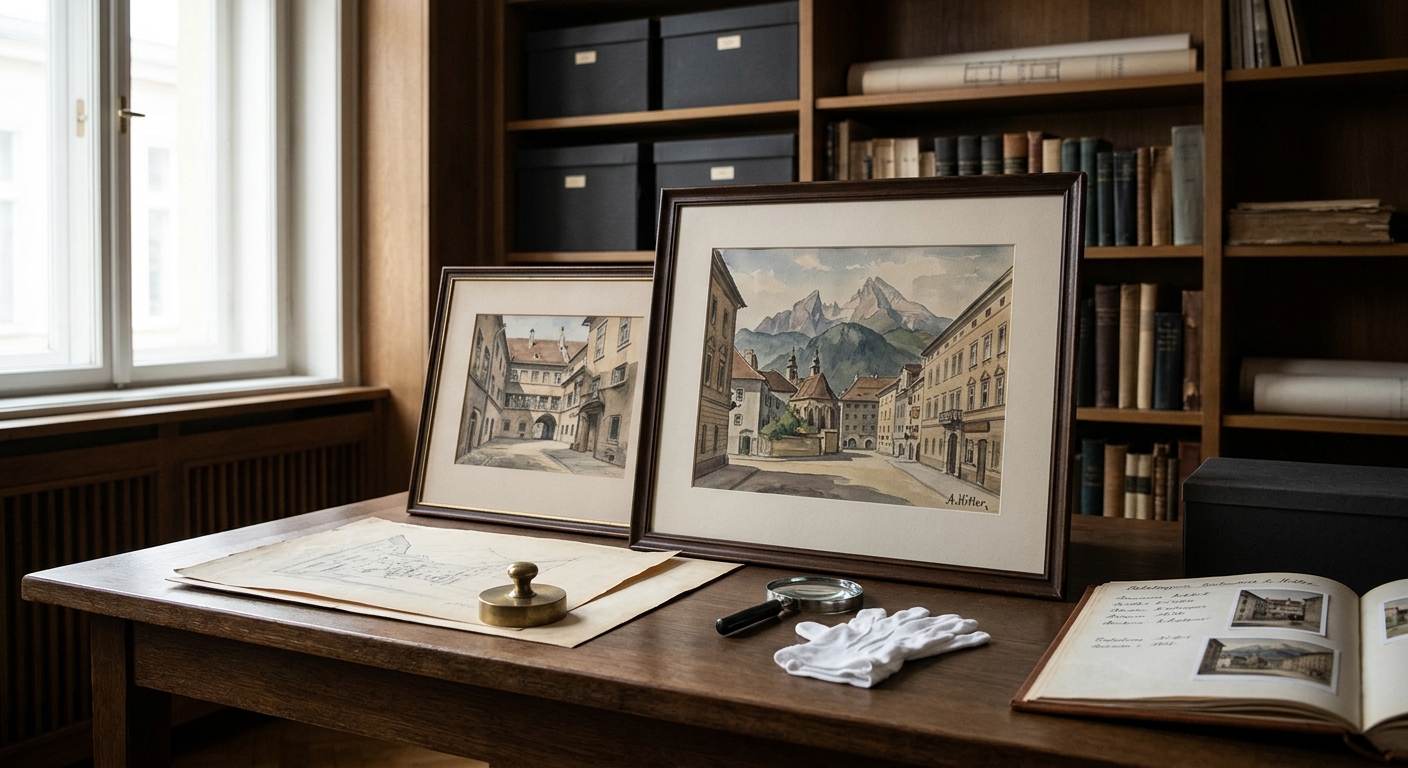
Before achieving national power, Adolf Hitler tried to make a career as an artist. Twice he was refused admission to the Vienna Academy of Fine Arts, and he survived by selling a few watercolors and drawings. These pictures are still available; therefore, people search for Adolf Hitler’s Paintings in curiosity, for research, or even after reading news about auctions.
The article provides information about the content of the paintings, their quality, preservation, and value. Some paragraphs include interesting facts about art ownership and potential purchases, like why it is problematic to buy the third piece of artwork or what the price of ownership is. The points below retell the article, highlighting the most significant ideas and raising different topics from the original text. All the statements are factual and based on research, without any praise or exaggeration. It might be valuable for art historians to consider the reliability of sources when studying Hitler’s art legacy.
Was Adolf Hitler Really a Painter?
Indeed, in a limited way. Hitler painted watercolors, sketches, and some oil paintings, mostly between about 1905 and 1914, and again as a soldier in the First World War. He mainly gave up after getting into politics, although he retained a passion for sketching architecture throughout his life.
The phrase “Adolf Hitler painter” can be misleading since he was never a professional painter, and his work was only an amateurish hobby that he occasionally practiced. Hitler was an amateur with a certain amount of talent, who sold his drawings for a living during a lean period in his youth.
15 Artworks, Themes and Insights
- The Vienna rejections (1907 and 1908)
Hitler had two applications rejected by the Academy of Fine Arts in Vienna, and none of his drawings survived the intervening years. Contemporaries report that Hitler drew human figures that showed insufficient understanding of this subject, so he was advised to study architecture. Most of the portfolio was lost, so this is more of a red herring than a genuine counter-argument.
- Vienna cityscape watercolors

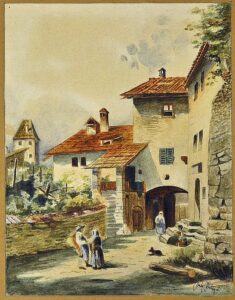
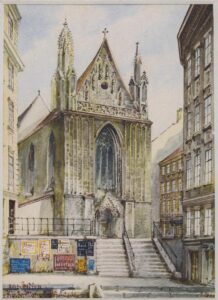
His most common subjects during his time in Vienna were the city’s churches and palaces, the best known of which is the Karlskirche. They were intended as tourist souvenirs and purchased by locals and visitors. Most paintings attributed to him today are small-scale and reasonably priced at the time.
- Copies from postcards and prints

It has been observed by historians that many of his early works were based on postcards, not painted from life. This is relevant to authenticity because the same set of images could yield dozens of similar forgeries.
- Buildings over people

Buildings dominate his pictures, often dwarfing any figures present. This is consistent with the Academy’s criticisms, but it also allows forgers to exploit this feature when attempting to mimic his style, since figures are harder to capture.
- Ruins of the Church at Messines (1914)
Hitler spent the First World War fighting on the Western Front. A watercolor of the ruined church at Messines in Belgium is one of the most famous images associated with his time there. It is remarkable because it is an architectural fantasy painted in the style he used to decorate his apartments in Linz.
- The Courtyard of the Old Residency in Munich
After moving to Munich in 1913 he painted local landmarks. A view of the courtyard of the Old Residency from about 1914 is often shown in books and used in sales pitches. As with all of his paintings, specific claims of authorship should be checked against documented provenance.
- Munich’s New Town Hall
A watercolor of Munich’s Neues Rathaus was said to have sold at an auction in Nuremberg in 2015 for about 100,000 euros, according to news reports. Take that figure with a grain of salt and cross-check it before citing it.
- Still lifes and rural scenes
In addition to city views, he painted landscapes as well as farmhouses and the occasional still life. They’re generally considered the least distinctive and most heavily forged of his paintings.
- The dealers who sold his work
In Vienna and Munich he used intermediaries such as Reinhold Hanisch, who sold his pictures and later got into a fight with him. Some of his early buyers and framers were Jewish, a fact historians like to cite when discussing his youth. His business records are spotty, which goes part of the way to explaining the problems with provenance today.
- Architectural sketches of the 1920s and 1930s
His later drawings were not paintings intended for sale but designs. They include sketches for a monumental triumphal arch and a huge assembly hall, both well in advance of his power to realize them. Architect Albert Speer later worked from such designs. They are of historical interest because they illustrate his fixation on gigantic building projects.
- The Linz museum plan
Hitler imagined a major art museum in Linz, Austria, and ordered the acquisition of thousands of works by other artists, many looted. This shows that his interest in art went far beyond his own painting, and it connects directly to modern restitution cases. [INTERNAL TOPIC: Nazi-era looted art and restitution]
- Works seized after 1945
At the end of the war, Allied forces took many items from Nazi sites, including paintings credited to Hitler. A number ended up in government hands, including in the United States, where the Army’s art collection has long held Nazi-linked material. Current holdings and policies can change, so check official sources.
- The forgery problem
Forgeries are widespread. Konrad Kujau, the forger behind the fake “Hitler Diaries” of the 1980s, also produced paintings in Hitler’s style. Authorities in Germany have also taken action against suspect works offered for sale. Many experts caution that a signature alone proves little, since “A. Hitler” signatures are easy to imitate.
- Auction results and what drives them
Authenticated pieces have reportedly sold for anywhere from a few thousand euros to well above €100,000, depending on subject, size, condition and paper trail. Not everything sells: auction houses have reported unsold lots when buyers hesitated over legitimacy or reputation. Prices fluctuate, and sales are not always public, so any figure should be verified at the time you read it.
- Why the market is controversial
Some auction houses and dealers argue these works are historical documents. Critics say that sales risk glamorizing a perpetrator of genocide and could enrich extremists. Both views are real, and the debate is a big reason many mainstream galleries will not handle these works.
How Good Were Hitler’s Paintings?
Art historians are reasonably unanimous about him. He had adequate draftsmanship in architecture, good perception of perspective, and used colors with a certain degree of skill. However, he did not have an air of originality, passion, and skill in portraying people. The images are orderly, decent, and somewhat generic, like the works of countless hobbyists and postcard painters in his era.
This generic quality, in turn, defines the paintings’ value. They are valuable solely because of their author’s notoriety, which may be worth considering if someone asks you for thousands of dollars for your paintings.
Hitler Paintings for Sale: What You Should Know
- If you are searching for Hitler paintings for sale, you should know that, whether you are doing this for fun or for research, there are several things that you should bear in mind.
- Hitler paintings for sale may be legal in most countries, but the laws regarding their possession or trade may vary considerably.
- The authenticity of the painting is usually difficult to establish beyond a reasonable doubt, even when the work has a reliable appearance and a genuine signature.
- The provenance of the work is of critical importance, as documentation of ownership from past owners to the present owner constitutes the best proof of authenticity.
- The most trustworthy dealers will always provide you with the opportunity to obtain such information and avoid those who promise guarantees of authenticity.
- Finally, it may be hard to find a new buyer for the work because most mainstream auction houses refuse to sell such items, making it challenging to recoup the initial investment.
Adolf Hitler Paintings Price: Realistic Expectations
There is no absolute price list, as everything depends on:
- Authentication, which is the most critical factor.
- Subject, as certain paintings depict well-known places and events, which may increase demand.
- Condition, size, and other factors, like any other work of art.
- Provenance, including who has possessed the work and how it was kept.
- The seller and where the sale is held, as private sales and public auctions are two completely different things.
- Do not believe sellers who offer something inexpensive, as it is usually a fake, and those who guarantee that an investment will be profitable. The market is small and fickle.
Common Mistakes to Avoid
- Trusting the signature. It is the easiest feature to forge.
- Ignoring the source image. If a painting copies a known postcard, look at how closely, and ask whether the seller can show it predates the 1940s.
- Skipping independent expert review. Specialist opinions from historians or forensic analysts matter more than a seller’s certificate.
- Treating it as a simple art purchase. Ethical and reputational issues come with ownership.
- Relying on a single price report. Verify figures against the original auction record.
Where to See or Study His Art Responsibly
You are unlikely to find his work on display in major museums. Researchers usually study it through archives, published catalogs, and historical books. If you want context, look for scholarly work on his early Vienna and Munich years, and for institutional histories of seized Nazi-era property. [INTERNAL TOPIC: Hitler’s early life in Vienna]
For provenance and looted art research, an excellent external starting point is the German Lost Art Foundation database (lostart.de), which documents cultural property affected by Nazi persecution.
Key Takeaways
- Hitler was a minor amateur painter whose subjects were mostly buildings, based partly on existing images.
- His rejection by the Vienna Academy is well documented, but the works he submitted are largely lost.
- His architectural sketches are more historically revealing than his watercolors.
- Forgeries are common, so provenance matters far more than appearance or signature.
- Prices vary widely and should always be verified, and the ethical debate is as important as the financial one.
Final Thoughts
Adolf Hitler’s paintings are a minor part of art history, but they offer important insight into the ways reputation can affect value. The works themselves are competently executed, but bland depictions of buildings, often lifted from postcards and painted by a young man whose skill with figures was barely adequate for art school. Their sole reason for existing is the man who created them and the circumstances of their creation.
Frequently Asked Questions
How many paintings did Hitler make?
Estimates often reach into the low thousands when drawings and sketches are included, but there is no definitive catalog and many attributions are disputed.
Did Hitler paint in later life?
Very little. After the 1920s he mostly drew architectural plans, not finished paintings.
Are Hitler’s paintings valuable?
Some have fetched significant sums at auction, but the value comes from notoriety, not artistic quality, and authenticity is frequently questioned.
Can anyone buy them?
In many countries, sales are legal, but buyers should check local law and be very cautious about fakes.
