What Is Form in Art? Understanding the Elements of Form
Take up an apple and turn it around. You may notice that there is a front, back, top, and bottom. Now, examine a picture of the fruit. It still appears round and tangible despite being on a flat plane of paper. The quality of appearing solid or actually being solid is referred to as form by artists.
If you are wondering what form in art is, the brief definition would be that form is an element of art that describes objects and those that have the illusion of height, width, and depth. It can be both actual, such as sculptured pieces or clay bowls, and implied through paint on canvas with a masterful use of shading and perspective.
This guide will explain what is meant by form in art, its qualities and characteristics, how it ties in with other elements of art, the difference between form and shape, and how to use it. Here are some definitions of what is form in art to understand the elements of art.
What Are the Elements in Art?
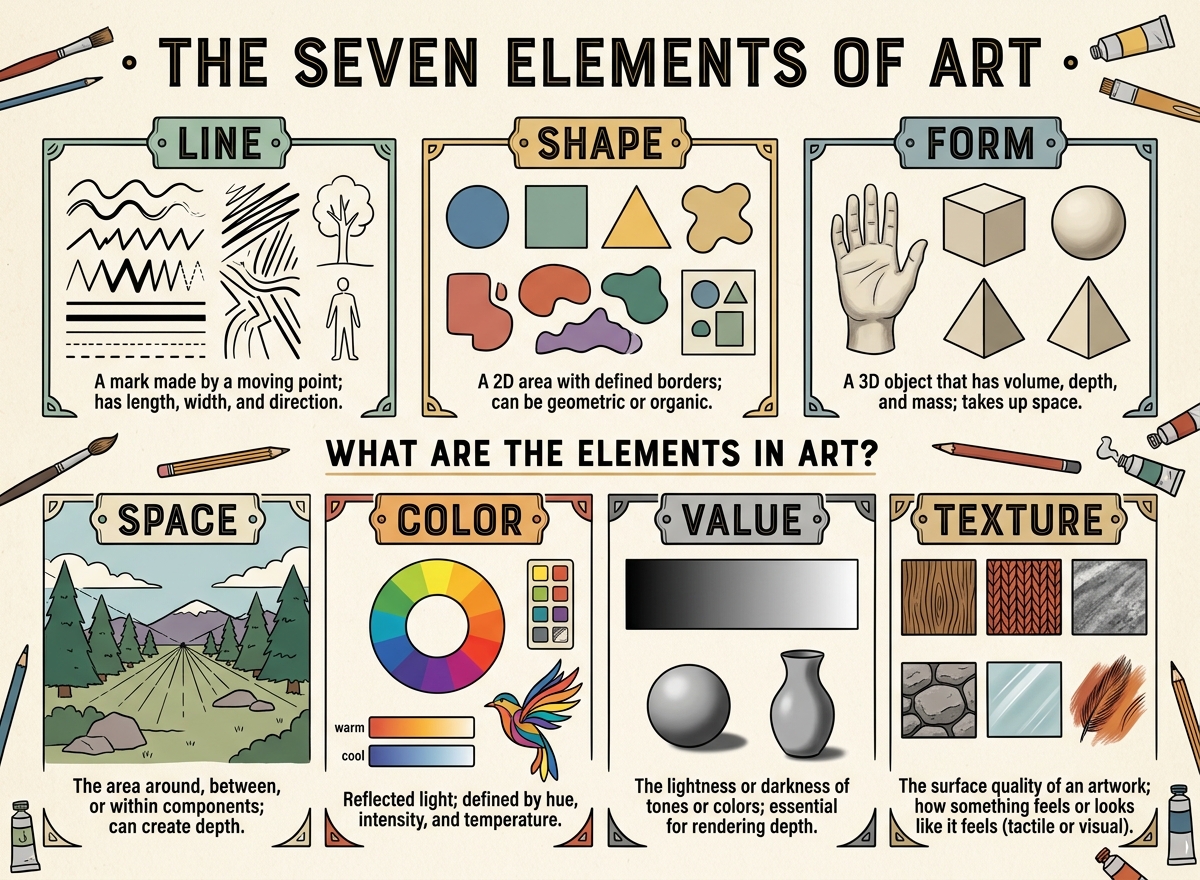
Before getting into the specifics of form, it is helpful to briefly discuss its place in the hierarchy. Most commonly, art education systems use the phrase ‘elements of art’ to refer to the basic visual building blocks that make up any artwork. The elements of art definition is simple — they are the fundamental components an artist uses to create a work, and the things we look at when describing or analyzing it. The most commonly taught elements of art include the following seven:
- Line
- Shape
- Form
- Space
- Color
- Value
- Texture
Depending on the teacher or the textbook, ‘mark’ or ‘mass’ elements may sometimes be added, or grouped differently. The exact list of elements of art can vary by curriculum, so double-check with your course guidelines if you are looking to identify the specific components for a class. The element of form takes a special place in the hierarchy — as can be seen, it is heavily reliant on the others. Any drawn form requires line to define its edges, value to add volume, and space to exist in. In a way, understanding form relies on being able to recognize the interplay of the other elements.
Form Defined: Real and Implied
Form has two types of modes, and they are as follows:
Actual (physical) form
Actual form is one that is three-dimensional in reality, existing in the physical world. It can be seen from different points of view and will cast shadows from different angles as well. Such forms are sculptures, ceramics, architecture, installations, and even a simple wooden spoon.
For example, Michelangelo’s David is a perfect example of actual form because it is carved fully in the round so that the viewer gets a different impression depending on the angle they look at the work. Another example may be Anish Kapoor’s Cloud Gate in Chicago – a huge sculpture made from polished stainless steel, which changes its reflection depending on the viewer’s location. Even a simple toy made of wood can be an example of an actual form.
Implied (illusionary) form
An illusionary form also has a three-dimensional appearance, but it exists on a two-dimensional surface. A painter, illustrator, or a photographer uses shading and other techniques to make their subjects appear three-dimensional. The most common techniques are:
- Shading and value– which help to create an illusion of volume by displaying shadows cast on an object;
- Overlapping – elements overlap each other, creating a sense of depth;
- Linear and atmospheric perspective– the effect of objects getting smaller and less saturated as they get farther from the viewer;
- Foreshortening – a method of depicting an object at an acute angle to simulate perspective.
When we talk about forms, we usually refer to both types as they exist in a sculpture (actual) as well as in a painting (illusory). A sculptor working with marble and a portrait painter will have similar approaches when depicting forms in their works.
Form vs. Shape: The Difference That Trips People Up
This is the most common confusion for beginners. Shape and form are related, but they are not the same thing.
| Shape | Form | |
| Dimensions | Two: height and width | Three: height, width, and depth |
| Nature | Flat, defined by an outline | Has volume and occupies space |
| Examples | Circle, square, triangle | Sphere, cube, pyramid |
| How it is shown | Line and flat color | Value, shading, perspective, or real material |
A circle drawn with a pencil is a shape. With shading so that it looks like a ball on a table, it is a form, a solid object. One simple solution is to think of shapes as flat and forms as having volume.
You can see the difference in the most basic geometry. A square becomes a cube, a circle a sphere, a triangle a pyramid or cone. Artists begin their work by simplifying the objects in their field of vision, reducing them to these basic forms before proceeding to add shading and detail. The post-impressionist painter Paul Cézanne once wrote to his colleagues that he thought of nature as being made up of cylinders, spheres, and cones, a philosophy that many painters have adopted since.
Geometric and Organic Forms
Forms are often grouped into two broad categories.
- Geometric forms are those that are regular, mathematical: cubes, spheres, cylinders, cones, pyramids. They have a feeling of order, stability, and are man-made. Most buildings, furniture and machines are made from geometric forms.
- Organic forms are those that are irregular, flowing and usually found in nature: a pebble, a leaf, a human body, a cloud. They have a feel of softness, a sense of life.
- Neither is better. Many great works of art combine the two. The British sculptor Henry Moore is famous for his smooth, flowing, hollowed-out, curved forms: organic forms, but the Romanian sculptor Constantin Brâncuși’s Bird in Space series simplifies a bird to a slender, polished, almost geometric form, which suggests the idea of flying.
How Form Works With the Other Elements of Art
Form rarely appears in isolation; here is how it works with its neighbours, two of the terms being those that people most often search for alongside it.
Line
- The line definition in art is a line drawn between two points, one with a length much greater than its width; it may be thick or thin, straight or curved, actual or implied.
- In drawing, line can define form with contour lines, those which follow the surface of an object, and curve around it. Compare a simple outline of a cup to a cup drawn with lines curving around the body of the cup. The second looks rounder as these lines behave as though they were a slice through a three-dimensional object. In sculpture, line appears in edges, creases, and the direction of the carved grooves.
Value
The value definition in art is the relative lightness and darkness of a colour or tone, from pure white through grey to black. Value is the single most important tool for creating the illusion of form on a flat surface.
Light falls on a solid object predictably. On a simple sphere lit from one side, you can usually identify these parts:
- Highlight: the brightest point where light hits most directly.
- Light area (midtone):the lit area leading away from the highlight
- Core shadow:the darkest band on the object itself, where the surface turns away from the light
- Reflected light:a small area of light within the shadow, bounced from nearby surfaces
- Cast shadow: the shadow the object throws on the surface beneath it
The gradual change from light to dark over the curve of a surface is what tricks the eye into thinking it is three-dimensional. A sudden change is an indicator of an edge or corner. Painters working in a style called chiaroscuro, such as Caravaggio, used stark contrasts of light and dark to create almost sculptural figures.
Space
Form occupies space, and space surrounds form. Artists talk about positive space (the object itself) and negative space (the area around and between objects). In sculpture, negative space is often part of the design. Henry Moore’s pierced, hollowed-out forms are a good example.
Texture and colour
Texture is how a surface feels or appears to feel. Rough, glossy, soft. A smooth marble surface can appear completely different to a rough clay one, even if the two surfaces have the same form. Colour also affects form; warm colours tend to advance, and cool colours tend to recede. This can subtly push parts of a painted form forward or back.
Form in Different Art Types
Sculpture. The most straightforward use of form. May be freestanding, seen from all sides, or relief, attached to a flat background. Low relief (bas-relief) suggests form, like the image on a coin, while high relief projects far enough to almost separate from the background.
Painting and drawing. Form is suggested by the artist. The artist analyzes light and edges to imply volume.
Architecture. Buildings are forms you navigate. The architect evaluates mass, the importance of space, and the effect of light on surfaces at various times of day.
Ceramics and craft. A pot must be both function and sculpture, pleasing from all sides. Handles, spouts, and the curve of the belly are all decisions about form.
Photography. Photographers suggest form by direction of the light. Light from the side shows volume, while light coming directly forward can make objects appear flat.
A Simple Exercise to Understand Form Yourself
You do not need special skills to test this. Here is a practical exercise that works with pencil and paper.
- Set up a light.Place a white egg, a ball, or even an apple on a plain surface. Use one lamp from one side. A single strong light source makes patterns easier to read.
- Outline first.Lightly sketch the shape. At this stage, it is still just a shape.
- Map the light and shadow.Squint at the object. Squinting reduces detail and helps you see big value groups. Mark where the darkest and lightest areas are.
- Build value gradually.Start with a light tone across the shadow side, then deepen it. Leave the highlight as bare paper.
- Add the cast shadow.This anchors the object to the surface. Without it, the object floats.
- Add reflected light.Lift a little tone back into the shadow edge so it does not look like a black hole.
- Look at your drawing next to the real object. Where does yours look flatter? That is usually where the value change is too abrupt or too even.
Repeat the exercise with a cube, a cylinder, and a cone. Cubes show sharp value changes at corners, while spheres show smooth ones. Noticing that difference teaches you more about form than reading any definition.
Common Mistakes When Working With Form
- Relying on heavy outlines.A thick dark outline around an object can flatten it. Real objects do not have outlines, only edges where one value meets another.
- Using the same value everywhere.If your light and dark areas are too close together, the form looks washed out.
- Skipping the cast shadow.This makes objects look pasted onto the page.
- Making shadows solid black.Shadows usually contain reflected light and subtle variation.
- Ignoring the light source.If shading comes from several directions without a reason, the form becomes confusing.
- Drawing what you think you know, not what you see.Beginners often draw an eye or hand as a symbol. Observing the actual volume, planes, and light is what produces form.
- Forgetting the back.In sculpture, a piece that looks good from the front but weak from the side is a common issue. Walk around your work regularly.
Why Form Matters
I think that form is what gives art its materiality. A convincing form suggests volume, something that could potentially breathe. The building depicted in a particular construction has volume, which means it has mass. The same goes for the forms that appear to be massive – they seem stable and substantial. On the contrary, the one that seems elongated, light, and tenuous appears less stable, and the one that seems to flow freely can be easily broken, bent, or crushed.
Understanding forms will allow you to analyze works of art more closely. For instance, next time you go to an art museum, having studied forms will allow you to ask yourself more questions in a shorter period of time. Looking at the items in front of you, you can start formulating the following questions: Is the form actual or suggested? Is it geometric or organic? Where is the light coming from? And how does the artist use values to depict the forms? These questions will help you navigate the art you see in less than a minute.
Final Takeaways
- Form is the three-dimensional element of art, with height, width, and depth.
- It can be actual(sculpture, architecture) or implied (a drawing or painting that suggests volume).
- Shape is flat; form is solid.
- Value, especially the transition from light to shadow, is the main tool for showing form in two dimensions.
- Line, space, texture, and color all support how form is understood.
- Practice with simple objects under a single light before tackling complicated subjects.
Frequently Asked Questions(FAQs)
What is form in art in simple words?
It is the solid, three-dimensional quality of an object, either real or made to look real.
Is form one of the seven elements of art?
In the most commonly taught list, yes. Line, shape, form, space, color, value, and texture are the standard seven, though some curricula vary.
Can a painting have form?
Yes. A painting cannot have real depth, but artists create implied form using shading, perspective, and overlapping.
What is the difference between form and shape?
Shape has two dimensions, while form has three. A circle is a shape, and a sphere is a form.
What are examples of forms in art?
Michelangelo’s David, Henry Moore’s reclining figures, Brâncuși’s Bird in Space, Kapoor’s Cloud Gate, and any well-shaded still life painting or drawing.