75+ Abstract Art Ideas to Inspire Your Creative Side
Looking at a white canvas before you need to paint something is a scary moment. When there is no reference photo on hand, it can be incredibly challenging to know where to begin. abstract art ideas is the one style that is the easiest for the artist to practice but most daunting to start due to the lack of direction or specific guidance needed to produce any given piece.
This guide is designed to provide inspiration and jump-start your abstract painting sessions no matter your skill level. There are actionable lists and suggestions of ideas based around themes, techniques, and emotions that you can use to begin painting straight away, without needing any guidance or resources other than your own artistic talent.
What Makes Art “Abstract,” Really?
Abstract art is art that does not aim to represent a particular object, figure, or scene realistically. It focuses on expressing feelings and concepts, using elements such as color, shape, line, texture, and others. Some of the abstract artwork will have images of real-life objects, landscapes, and people. Other abstract art is nonspecific, and the only emphasis is made on the composition of colors.
There is not one right style for abstract art, and there are many variations for expression. The most common types of abstract art are:
- Gestural – this type usually represents the artist’s gesture;
- Geometric – this style is characterized by clear shapes;
- Textural – the main focus is on the texture;
- Color field – this variation uses color to create the composition;
- Mixed – this type combines various materials.
These are just some of the most common abstract art examples. It is essential to understand what style you like to choose the right ideas for creation.
Easy Abstract Art Ideas for Beginners

If you are a novice in the world of abstract painting, you will probably want to try out some less intimidating approaches before attempting a real masterpiece. Below are several ideas for you to experiment with; all of these techniques are process-driven and make the act of creating art less stressful since you cannot really do anything wrong.
- Drip painting – thin the paint and let it drip or pour on a tilted surface.
- Palette knife blending – use a palette knife to apply thick strokes of paint and blend 2-3 colors where they meet.
- Masking tape geometry – use masking tape to mark the edges of shapes and paint over them, then remove the tape.
- Monochrome study – use one color and various shades of it to paint a picture.
- Sponge texture – daub the surface of the canvas with a sea sponge to create interesting patches of color.
- Salt technique (for watercolor): add salt on the wet paint to make it pitted.
- Bubble wrap impressions – use bubble wrap as a stamp and press it on the canvas covered in paint.
- Straw blowing – blow bubbles of thin paint with a straw to create whimsical shapes.
- String pulling – dip a string in paint and lay it on the canvas, then fold the canvas over the string and pull it out.
- Scraping method – paint the canvas with thick strokes of paint and use a comb or a piece of cardboard to scrape some paint off.
I believe these are all great ideas for a novice painter to try their hand at abstract art since most of the happy accidents that occur in the process can be mistaken for intentional brushstrokes by someone more experienced.
Abstract Art Painting Ideas Based on Color Theory

Color is where the heart of the matter lies in abstract painting. By grasping a handful of fundamental connections, you will be able to design agreeable compositions rather than random assortments of color.
- The clash of complements – place colors opposite each other on the color wheel (yellow-purple, blue-red) to create a vivid contrast.
- Analogous scheme – choose three colors that are next to each other on the color wheel.
- Monochrome with an accent – use one color family to paint your composition and add a few shades of another one to it.
- Warm and cool halves – divide your canvas into warm and cool colors.
- Gradient – blend one color into another.
- Triadic color scheme – pick three colors that are spaced equally apart on the color wheel.
- Desaturated – add some gray or complementary colors to make the image less saturated.
- Neon on black – use black as a background color and add a few neon colors.
- Earth color – use earth colors to create an image.
- Pastels – use pastels to make a picture.
One common mistake that amateurish artists make is to use too many different colors in their artwork. If you want to achieve an agreeable composition, you should use no more than 3-4 colors for an image. It would turn out much more presentable than trying to use all the colors from your palette.
Emotion and Mood-Based Abstract Ideas
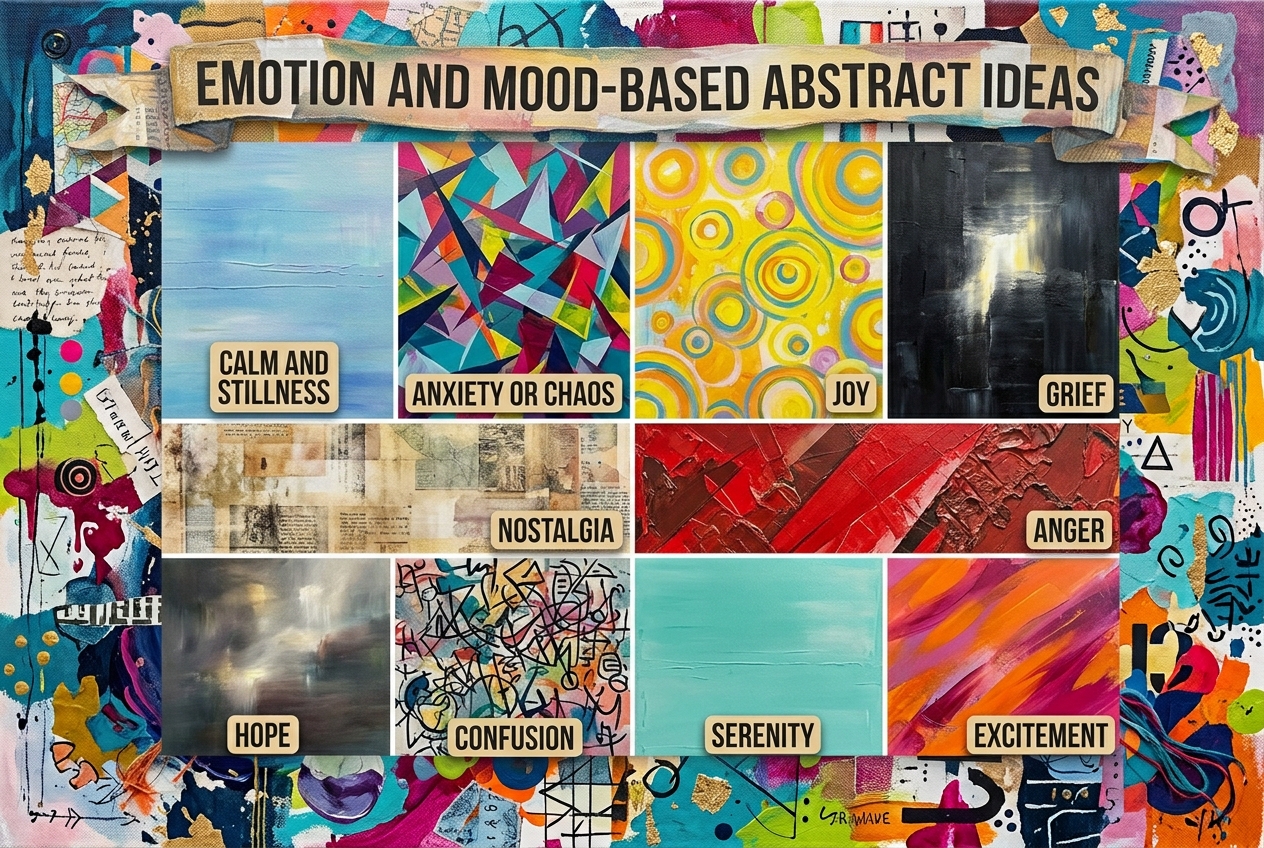
Abstract art is often at its strongest when it starts from a feeling rather than a technique. These ideas give you an emotional starting point.
- Calm and stillness, using soft blues and horizontal lines
- Anxiety or chaos, using jagged, overlapping shapes
- Joy, using bright yellows and circular, bouncing forms
- Grief, using heavy dark tones with a single light break
- Nostalgia, using faded, sepia-toned layers
- Anger, using sharp red diagonals and rough texture
- Hope, using light breaking through a dark palette
- Confusion, using overlapping, tangled linework
- Serenity, using large, uninterrupted fields of a single color
- Excitement, using dynamic diagonal movement and warm colors
Try picking a single word before you start painting, then let that word guide every decision (color, brush pressure, pace) rather than planning the final image.
Geometric and Pattern-Based Abstract Ideas
If freeform painting feels too unstructured, geometric abstraction gives you rules to follow while still leaving plenty of room for creative choices.
- Overlapping circles in varying transparency
- Grid-based color blocks, like a modern quilt pattern
- Concentric squares (similar to target compositions)
- Triangular fragmentation across the canvas
- Op-art style repeating lines for a visual vibration effect.
- Honeycomb hexagon tessellation
- Radiating lines from an off-center point
- Stacked horizontal bands of varying thickness
- Diagonal stripe interruption across a solid color field
- Fractured mirror effect using angular shard shapes
Nature-Inspired Abstract Ideas
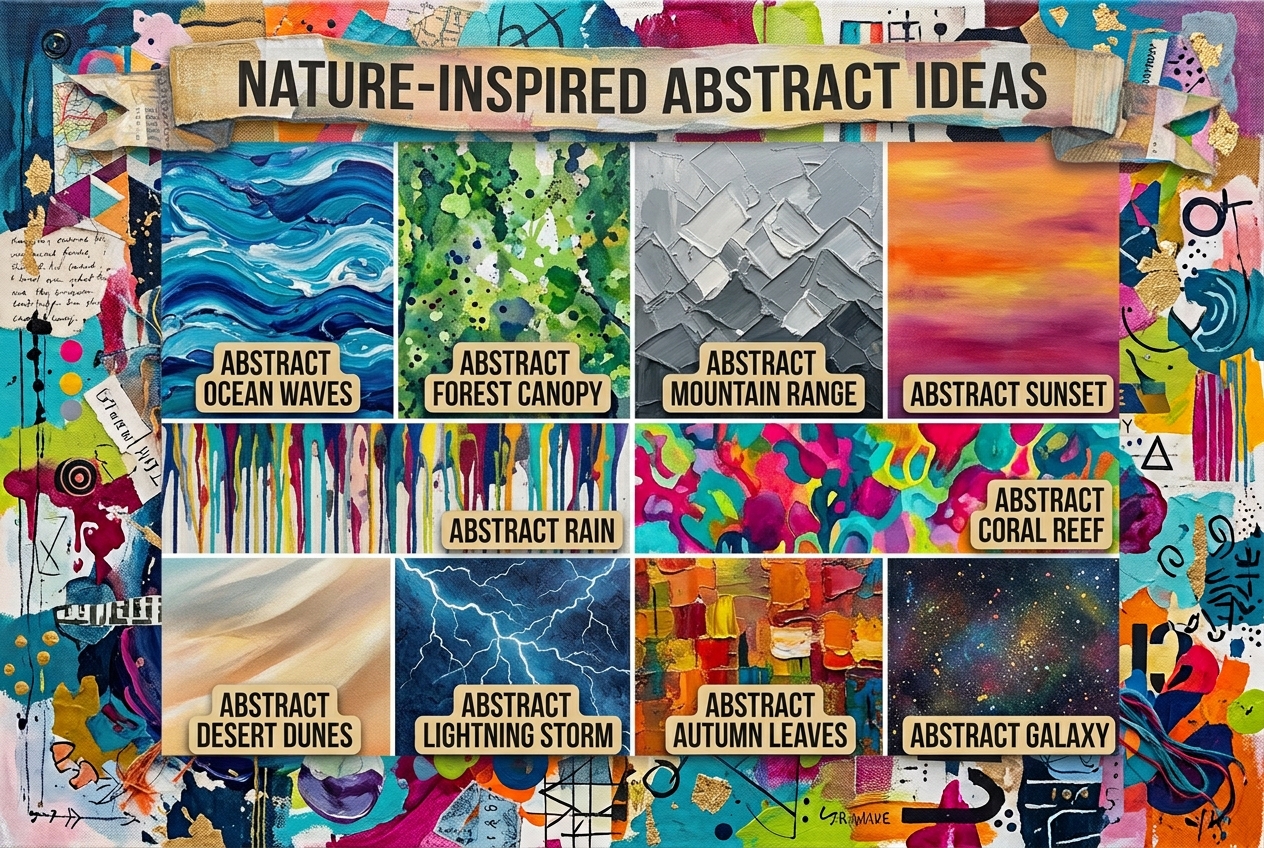
These pull loosely from real-world subjects without trying to paint them literally, a great middle ground between representational and pure abstraction.
- Abstract ocean waves using flowing blues and whites
- Abstract forest canopy using layered greens and light gaps
- Abstract mountain range using angular gray and white shapes
- Abstract sunset using a warm gradient wash
- Abstract rain using vertical drip lines
- Abstract coral reef using organic shapes and saturated color.
- Abstract desert dunes using soft, sandy gradients
- Abstract lightning storm using sharp white cracks on dark blue
- Abstract autumn leaves using warm, textured color blocks.
- Abstract galaxy or nebula using dark backgrounds with speckled light
Texture-Focused Abstract Ideas
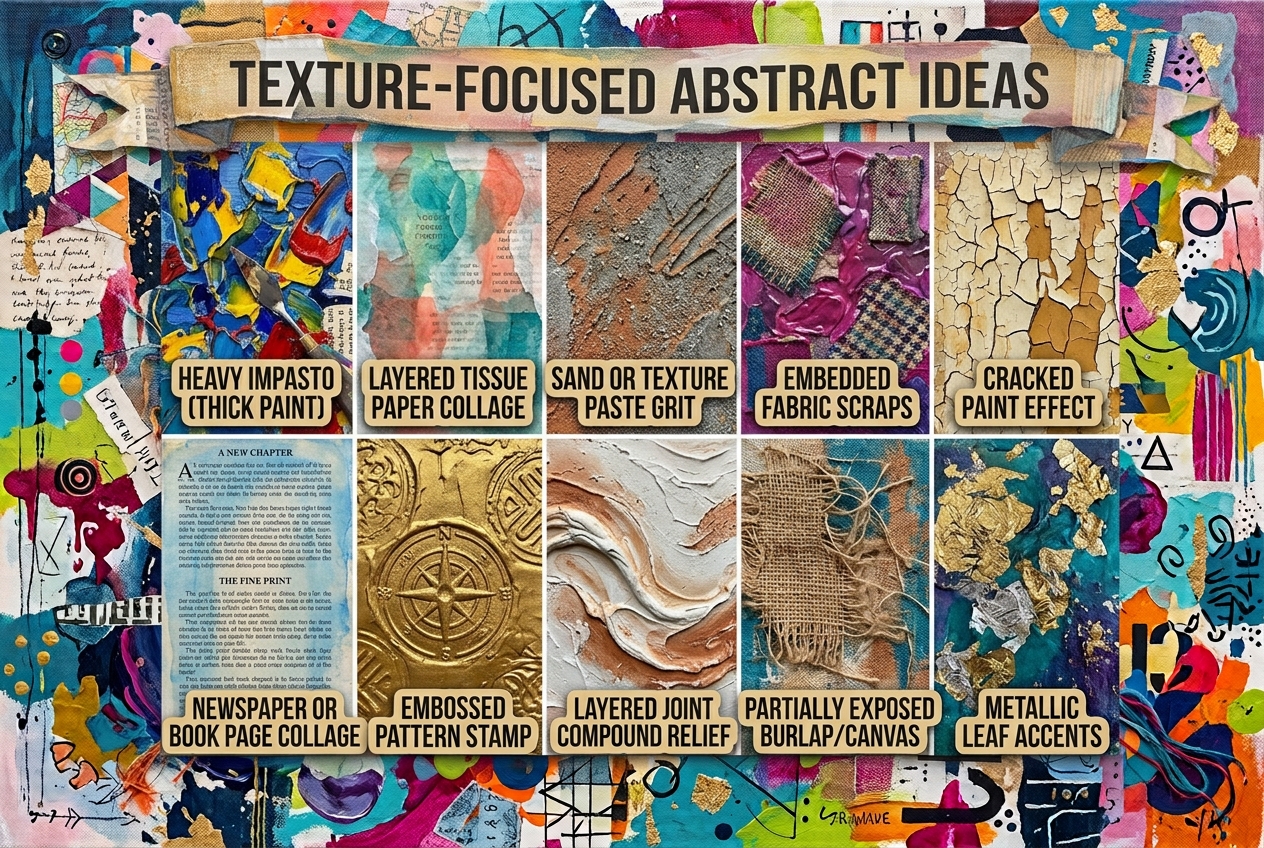
Texture adds a tactile, dimensional quality that flat color alone can’t achieve. These ideas work especially well with acrylic or mixed media.
- Heavy impasto (thick paint) applied with a palette knife.
- Layered tissue paper collage under thin paint washes
- Sand or texture paste mixed into acrylic for a gritty surface
- Fabric scraps embedded into wet paint.
- Cracked paint effect using texture gel that dries and splits
- Newspaper or book page collage as an underlayer
- Embossed pattern pressed into wet paint using a stamp.
- Layered joint compound for a plaster-like relief surface
- Burlap or canvas texture left partially exposed
- Metallic leaf accents pressed into wet medium.
Ideas for a Series (Not Just One Painting)
Painting a single abstract piece is satisfying, but working in a series builds skill faster and often results in more cohesive, gallery-ready work.
- A four-season series, one painting per season, same palette structure
- A “one color, five ways” series exploring a single hue’s range
- A diptych or triptych that reads as one image across multiple canvases
- A “day and night” pair using inverted light and dark values
- A five-piece series based on the five senses
- An emotional journey series, from chaos to calm across three pieces
- A city skyline series abstracted into color blocks.
- A “before and after” pair reflecting a personal change or event
- A numbered series exploring the same shape in different color schemes
- A collaborative series where each piece responds to the one before it
Quick-Start Ideas When You Have Limited Time or Supplies
Not every abstract idea needs a full studio setup. These are approachable with minimal materials.
- A 15-minute timed painting using only three colors
- A single-brush painting (no palette knife, no tools, just one brush)
- A postcard-sized abstract sketch using leftover paint from another project
- A black-and-white ink abstract using just a pen and paper
- A digital abstract sketch using a free drawing app, printed later as reference
- A “scrap paint” canvas, using only the paint left on your palette from previous work
- A one-color-per-day mini series painted on small cardstock
How to Choose the Right Idea for You
With 75+ options, narrowing down can feel overwhelming. A simple way to decide:
| If you want… | Try this category |
| Fast, low-pressure results | Easy abstract art ideas (drip, sponge, scraping) |
| To understand color better | Color theory-based ideas |
| To process a feeling | Emotion-based ideas |
| Structure and precision | Geometric ideas |
| A softer, familiar subject | Nature-inspired ideas |
| Dimensional, tactile work | Texture-focused ideas |
| To build a body of work | Series ideas |
Common Mistakes to Avoid
- Overworking the piece. The abstract painting was meant to be finished earlier than it was. Continual working of the painting led to muddying the colors and ruining the spontaneity of the painting.
- Use of too many colors. Using more than three to five colors, including the neutrals, when completing an abstract painting is too many.
- Not taking the basic design concepts into consideration. Although there may not be a specific subject, elements such as balance, focal point, and negative space should still be considered.
- Painting what one sees when using a reference photo or nature. When working from a reference photo or nature, it is best to go beyond what one sees; this is where the abstraction should occur.
- Not planning the design. Abstract paintings do require some planning. Even a rough thumbnail sketch of the value and color placement can help avoid a muddied painting.
Materials Worth Having on Hand
You don’t need to invest heavily in the equipment to begin your art journey. Here is a list of the basic supplies that every beginner should have:
- Acrylic paints to learn the technique of quick drying and layering.
- Several types of paintbrushes, including the palette knife.
- A canvas, canvas board, or a heavy mixed-media paper.
- Masking or painter’s tape.
- An old sponge, a credit card, or a comb to create unique effects.
Final Thoughts
The most challenging aspect of creating abstract art ideas is not the skill; it is finding the right ideas to work with. Pick something from this list that interests you, set a short period of time, and go with it, rather than trying to overplan what you intend to do.
abstract art ideas is all about experimenting, and some of the best results come from ideas you had little faith in.
Watercolors and inks are also great for abstract painting. It is advisable to experiment with salt, sponges, and gradients to achieve the necessary effects.
Frequently Asked Questions(Faqs)
Is abstract art more difficult to create than realistic art?
Not really; it’s a matter of having a different skill set. Composition and color are more important factors in the creation of abstract art. Most beginning artists find that abstract art is easier to create than realistic art.
Is it necessary to study art to create abstract art?
Not really; most of the best abstract art is created by artists who ‘play with the paint.’ But if you study and educate yourself in color theory and composition, you will likely be a better abstract artist.
How do you know when an abstract painting is done?
There is no clear answer to that question. In general, you should stop when adding things would just bring attention away from the main subject of the painting. Or, even better yet, take a break and come back to the painting and ask if adding or removing something would improve the painting.
What is the difference between abstract art and non-objective art?
Abstract art often makes use of recognizable objects or places that have been altered to make them unrecognizable. Abstract art, then, is art that has been made abstruse. Non-objective art lacks objects or places that have been altered or are unrecognizable. Abstract art and non-abstract art are both general categories that fall under the umbrella of ‘abstract art.’