Cool Art Ideas to Spark Your Creativity
Most people who say they want to make art are not lacking in talent. They lack a starting point. A blank canvas offers too many options, and nothing ever gets done.
This guide will give you some very specific, cool art ideas that you can start with materials you probably already have, and a way to decide which ones are right for your time, budget, and skill level. You don’t need to be particularly artistic. Most of the best projects below are actually pretty easy on your skill level.
How to Pick an Idea That Fits You
Before you start choosing which projects to do, let’s answer these three questions.
- How much time do I have? Do I have 20 minutes to spare, or an entire afternoon?
- How much mess am I willing to deal with? Do I want to do something fancy like marbling with shaving cream, or something simple and fast like pencil line drawing?
- Do I want to learn a new skill, or do I want to do something relaxing? Both are great options, but they will lead you to different projects.
Here is a chart of the projects below.
| Idea | Time | Mess level | Skill needed |
| Continuous line drawing | 10 to 20 min | None | None |
| Salt and watercolor | 30 min plus drying | Low | None |
| Wax resist painting | 30 to 45 min | Low | None |
| Blackout poetry | 15 to 30 min | None | None |
| Magazine collage | 45 to 90 min | Low | Low |
| Shaving cream marbling | 30 min | High | None |
| Air-dry clay pinch pots | 1 to 2 hours plus drying | Medium | Low |
| Found-object assemblage | 1 to 3 hours | Low | Low |
Times are rough estimates and vary by person and by how much you let a piece dry.
Easy Art Ideas You Can Start Today

Create your artwork, which might come out surprisingly well. Simple, and no effort required! Some of these things are really easy to do. They’re flexible and don’t mind if the work doesn’t turn out how you thought it should. I’m going to explain the following activities to you:
Continuous Line Drawings
Use some kind of object, like your hand, your favorite plant, or even your mug! Draw it, but make sure you don’t lift your pen off the page or change direction. Just let the line twist and turn and flow. The constraint of this drawing is the point. Since no erasing or lifting is allowed, it lets you focus on the shapes. It’s pretty common with these drawings that people start getting weird results that look more like doodles than actual portraits or objects. So this is perfect for people who struggle with traditional media like pencils and pens!
Practical tip: Use a pen, not a pencil. Pencil seems like it’d be more flexible, but it’s just the opposite.
Salt and Watercolor
On watercolor paper, paint some random washes of watercolors. While it’s damp, sprinkle some salt on it. When it’s dry enough, the salt will absorb some of the pigment, creating different starbursts of color. It’s the perfect thing for making things like frost or a night sky with stars. Salt and watercolor are an easy way to create abstract, wintry impressions. The timing is key; salt on the really wet paint will just make a blobby mess. The salt should have been added before the watercolor has firmed up, but after the watercolor has lost its glossy look.
Wax Resist Painting
Sketch your desired design using either a white colored crayon or candle stub on a white piece of paper; afterwards, color over it with watercolor, making sure that you get every crack and crevice filled up. The wax will resist the watercolor, letting your design magically appear before your eyes. It’s one of the best art activities for mixed age groups, since even the younger ones get to enjoy the surprise as well as an adult would. But make sure you press hard enough with your wax writing utensil to get a nice amount of resistance to work with.
Blackout Poetry
Go through old magazines, books, newspapers, or printed articles that you don’t mind destroying, and look for words that stand out to you. Black out the rest of the words with a marker. The words that you want to keep will make up your very own unique blackout poem. You can even color around the words, giving it a nice, artistic feel. It’s halfway between poetry and drawing, so that’s great news if you want to make art but don’t think you have any drawing ability. But make sure to save your blackout poetry projects in a place you can scan them to, or take a picture of them with your phone!
Fun Art Ideas Using Everyday Materials

It is not necessary to purchase a complete art kit. Some of the most interesting works are created using items already in the household.
Magazine and Paper Collage
This is the perfect activity for those who are intimidated by drawing, because the images are already provided. Just organize, cut out, and construct.
A few ideas to make it a bit more purposeful than a wad of magazines tossed on the floor:
- Create a collage that solely consists of one color family.
- Using various magazines, construct a face only using eyes, lips, and hair.
- Try tearing instead of cutting.
- Overlap the paper before gluing and fidgeting with the pieces for a few minutes.
Most of the construction happens during organization, so do not be in a hurry to stick the collage together.
Shaving Cream Marbling
On a surface, spread a layer of shaving cream that has been made only with plain foam (gel is not recommended). Drip a few drops of liquid food coloring onto the shaving cream and begin swirling the dye around with a toothpick or skewer. Lay a sheet of paper over the cream and lift the paper so the foam transfers to the paper. Use a ruler or a credit card to scrape off the excess shaving cream.
What you are left with is a marbled pattern on the paper. The activity is messy (both to create and clean), so it is best to do it on top of something you are not opposed to ruining. Test the technique on one sheet of paper first, because every brand of foam shaving cream and type of paper reacts differently.
The marbled pages can later be used as the background for cards, bookmarks, or collages.
Texture Rubbings
On a page of thin paper, place a textured surface (coins, leaves, brick, wood, etc.), and rub a crayon or pencil over the rough cover. The raised patterns will imprint onto the paper.
Gather a dozen textures, cut out the images, and use them to create a larger picture. It is a great game to play outside, because all that is needed is a handful of paper and a crayon.
Nature Mandalas
Using leaves, petals, pebbles, and twigs, create a circle on the ground. Take a photo of the design when you are satisfied with how it looks, and toss it into the wind.
Since it is only temporary, there is no need to feel hesitant about the impermanence of the creation. It is a relaxing way to create something without having to keep it.
Art and Craft Ideas That Make Something Useful

Some people like to have a purpose for their finished creation. The following projects are crafts and art projects that allow creative expression, as well as make something useful or a gift.
Air–Dry Clay Pinch Pots and Trinket Dishes
Air-dry clays are a wonderful material that does not require a kiln. Take a ball of clay and push your thumb in the middle and pinch the clay to make a small bowl. Make sure to smooth the pinch marks with a damp finger.
Two mistakes that are common with air-dry clays are:
Cracks: This happens when clay dries too fast or when there are thin places in the dried clay. Thin places usually happen when the maker flattens the clay too much. To prevent cracks, let the item air-dry, not in direct heat.
Fragility: Air-dry clay is delicate and porous. It is not waterproof or food-safe (unless it specifically says so on the package). Always treat air–dry clay items as decorative art or for dry storage and follow the directions on the packaging.
After the piece has dried, paint and seal the item. It makes a nice ring and key holder.
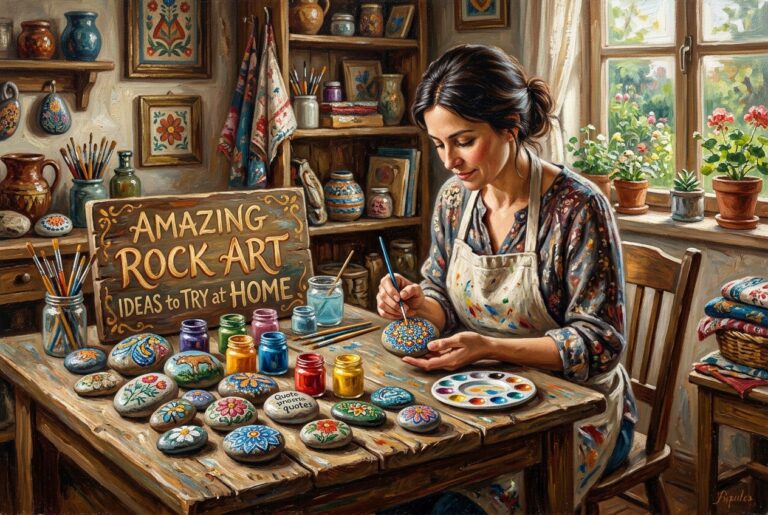
Painted Rocks
Washed river rocks are a great medium for small items. Paint and seal them with a sealer to make them waterproof. The wonderful thing about painted rocks is that the item is small enough to complete in an hour.
Found – Object Assemblage
Find small things to glue to a shadowbox or wood. Use similar colors or categories (such as things found in my grandmother’s sewing box) to make the item.
The hardest part of this project is deciding what to glue where. A collection of odd items can look like clutter, but things that make a statement are organized in similar categories.
Cool Art Ideas for When You’re Stuck
Sometimes it’s not the materials but the direction that you need to overcome a hurdle. Putting a limit can get you unstuck quicker than throwing open the doors of freedom.
- Limit your palette to just two colors plus black and white.
- Draw with your off hand to lower your expectations from the start.
- Set a timer for five minutes to do a rough sketch of the same item or person, then do it two more times.
- Re-draw something you like.
- Practice by copying the composition of a painting you like but change the colors or the subject.
- Illustrate a word. Choose one at random and do a quick sketch for it, like “borrowed” or “quiet.”
- Keep a prompt jar. Come up with some thoughts and write them on little slips of paper to pull out and use for making art day after day.
The prompts work well because they break down the wall of “what should I make”, and instead you have “how do I make this work”
Which Ideas Work Best for Different People
Kids: Wax resist, marbling, rock painting, and rubbings are fast projects with a noticeable result; younger ones may need help with clay, scissors, or small things.
Teens: Collage, blackout poetry, and assemblage are all about self-expression and don’t presuppose any particular drawing skills.
Adults: Continuous line drawings and salt watercolors may be used as a brief break from the daily grind. Try ten-minute sessions without any specific goal in mind.
Groups and families: Marbling, nature mandalas, and collective collage on a single sheet could be an option, as they presuppose collaboration without any specific individual skill.
Mistakes That Make People Quit
The reason most people stop making art is not that they have lost the ability but that they have encountered simple obstacles.
- Making it too big – it is a good idea to start working on smaller surfaces. Try sketchbooks or just pieces of paper.
- Buying the wrong supplies – in most cases, working with basic paper, pens, watercolor, and glue is sufficient to do most of the activities. Upgrading your materials should be based on what you already enjoy doing.
- Judging the results before they are complete – many of the activities, especially collage and watercolor, require time to dry or alter the appearance of the finished product. Try not to decide whether the result can be used until it is fully dried.
- Comparing your work to the work of others – the images you see online are often chosen or modified versions of the actual result. The first few attempts at creating art are unlikely to be perfect.
- Testing the materials on a separate sheet – if you are trying out a new effect, such as marbling or salt texture, test it out on a piece of paper that will not be used for an actual product.
- Following the instructions for materials – the packaging of various mediums will often suggest the proper use, such as ventilation for acrylic clay or children’s safety. The same applies to using spray sealers and other chemicals.
Final Thoughts
You don’t need a studio, a small fortune, or a lifetime of practice to create something worth seeing. Just pick an item from this list that interests you, set a clock, and commit to completing it, however badly. Then do it all over again. You’ll find that the more you make, the easier it is; the best way to get better at art is to actually do it, and these cool art ideas are the perfect introduction.
Frequently Asked Questions(FAQs)
What are some beginning art ideas that don’t require much skill or supplies?
Continuous line drawings, wax resist, and blackout poetry are all excellent choices to start with.
What would be a good group art project?
Shaving cream marbling and a collaborative collage are always hits. A group will create pieces at the same time with these activities.
Do I need to buy any supplies to do these activities?
For now, paper, a pen, crayons, scissors, glue, and a watercolor set will suffice. If you want to try the air-dry clay activity, you’ll have to get that at some point.
How can I find new art ideas if I get stuck and need inspiration?
You can limit yourself with challenges such as a color, a time limit, or a word to spark your imagination. You can look on museum websites for inspiration, too. Many have digital collections online that you can browse. You could even use a museum’s website for your art project if it has an education section. (Make sure to check the link and that it’s still valid before submitting)
Can adults do the activities with the same techniques as children?
Yes, they can. The techniques are essentially the same, but an adult might be able to execute them better with more intricate color choices and patterns.