Louis Wain Cats: The Story Behind His Famous Cat Paintings
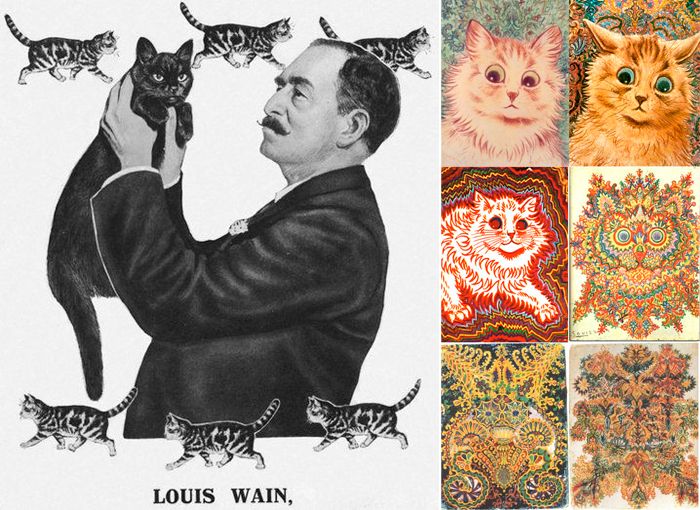
Search for Louis Wain, and you are very likely to come across the same image: a progression of cats that starts with an almost realistic tabby and turns into an explosion of colored geometry. You can find this creation in textbooks, social media posts, and psychology slideshows, confidently captioned to claim it proves something. The captions are the trouble. The images are genuine; the accompanying text is mostly guesswork. This article discusses who Louis Wain was, why he drew cats, how his style changed, and what psychology says about louis wain cats drawings.
Who Was Louis Wain?
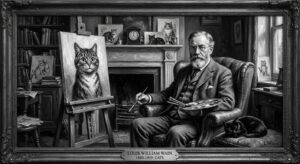
Louis William Wain was born in London in 1860 and passed away in 1939. He was the oldest son and the only son in the family, and he had five younger sisters. Wain studied art for a short time and pursued a freelance career as an illustrator. He started his professional career drawing animals.
There were two major factors that influenced his decision. First, he had to take care of his mother and sisters after his father’s death. Second, he married Emily Richardson, his sisters’ governess, who was around ten years older than him. She had breast cancer and passed away a few years later. According to Wain, a stray kitten named Peter, whom he brought home while Emily was sick, helped him cope with the difficult times. He was even convinced that Peter had prompted his feline drawings.
This version of events is most likely true, although the facts should be taken with a grain of salt since they were told by Wain himself.
Why His Cats Became So Popular
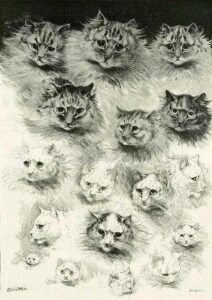
Wain’s early success was no accident – he gave cats personality, something they had rarely been given in Victorian and Edwardian illustration.
His most famous works from this period depict cats behaving like humans -playing snap, attending tea parties, riding bicycles, going to school, shopping and dressing for the opera. The humour is gentle and the facial expressions engaging -a trait which appealed to a public who were embracing domesticity and pets.
A few factors contributed to his appeal:
- His drawings were widely circulated -appearing not only in illustrated magazines but also in books, and in postcards and annuals, meaning that they were seen by many in the average household.
- Emotional expressiveness was key -viewers could instantly connect with Wain’s cats and read their human-like emotions, from smugness to anxiety to delight.
- He had a good grasp of the zeitgeist – cat-keeping and cat showing were on the rise in Britain, and Wain not only fed into the craze, but helped create it. He was president of the National Cat Club as well as a cat fancier himself.
The Money Problem
Despite his fame, Wain was notoriously bad at business. It has been established that he sold his work cheaply and had little control of copyright, so the great popularity of his images failed to translate into long-term security. He also had to support his sisters for years. His later episodes of financial hardship are well-documented.
This is significant because the conventional view of his decline is entirely psychological. It should be noted that his life was punctuated with grief, familial pressure, and chronic financial stress – all of which are relevant to any interpretation of his later work.
Wain’s Later Life and Hospitals
In the 1920s, Wain’s behavior became increasingly dysfunctional for his family. He was admitted to a pauper ward at Springfield Hospital in Tooting in 1924 and later transferred to Bethlem Royal Hospital and finally to Napsbury Hospital in Hertfordshire, where he spent his final years.
The campaign that helped him improve his living conditions is an illustration of his popularity. His admirers, among them the contemporaries’ elite, managed to get him transferred to a less harsh environment. At Napbury, he had access to a garden and animals in his vicinity and could continue his artwork.
Did Louis Wain Have Schizophrenia?
This is the question behind searches like “artist with schizophrenia cats” and “schizo cat artist,” so it deserves a direct answer.
The short answer: probably not provably, and the diagnosis is disputed.
Wain was described as suffering from some kind of mental illness. The popular phrase is that he had schizophrenia. But there are complications to this description.
There is no diagnosis for him today. He was diagnosed in the early twentieth century, and medical categories have changed since then.
Commentators disagree. Some other conditions have also been suggested. He may have had autism spectrum disorder, or the mental effects of a head injury or toxoplasmosis, a parasitic infection spread by cats. These are all suggestions, not certainties.
The evidence is circumstantial. A lot of what we know comes from letters, hospitals, and a few biographers. Diagnosis a century later is not reliable.
A responsible formulation would be that Wain suffered from serious mental illness in later life and that the condition cannot be diagnosed with certainty.
The Famous “Progression” Pictures

Here is the biggest myth. A set of cat images, presented in order, from realistic to abstract, is supposed to represent the course of his illness year by year. However, Wain’s actual work does not support such a neat timeline.
There are several reasons for this:
- First, many images are undated, as is known from the best-known abstract cats, which have no reliable dating;
- Second, Wain drew in several styles, including conventional realistic cats, so his later works do not necessarily follow the direction indicated
- The third reason is more formal: this particular arrangement was popularized by a psychiatrist’s presentation, which does not necessarily present reliable historical data. This version of the narrative was popular in critical essays of the mid-20th century, which examined the relationship between art and psychiatry, and has since been repeated many times, often without reliable evidence. So when you see this kind of progression, be aware that it is an interpretation of the image, not documented history. If you want to see documented history, be sure to ask for dated images.
What Changed in His Art
None of this means his style did not change. It clearly did. Looking at his work across his career, a few shifts stand out.
| Period | Typical look |
| Early career | Realistic or humanized cats in everyday scenes |
| Middle years | Larger, more energetic compositions with exaggerated expressions |
| Later years | Bold color, repeating patterns, flattened space, and more abstract faces |
Later cats often inhabit the whirling backgrounds, similar to their fur, so the animals and the environments mutually erase. Indeed, many viewers do find joy rather than unease, making a valid point. They can also be regarded as an artist experimenting with patterns, as many of his contemporaries were during that period.
Indeed, the only honest answer is that we can describe the transition but cannot unequivocally attribute each change to the specific disease.
Louis Wain’s Last Painting

People searching for Louis Wain’s last painting usually aim at finding one particular work of art. Indeed, there is none, as he continued to paint and draw even when he was on the verge of death. The majority of these works were not marked with dates, and the ones claiming to be the last ones were not actually supported by any reliable sources. What we know for sure is that the artist kept creating art pieces even when he was in the hospital, that Wain sold his work to support himself and others, and that he passed away in 1939 in Naperville.
Where to See Louis Wain Art
Wain’s work is held by museums, archives, and private collectors, and exhibitions have come and gone over the years. Because displays change, check each institution’s current listings before you plan a visit. Good places to start include:
- The Bethlem Museum of the Mind in London, which has a connection to his hospital years.
- The Wellcome Collection, which has held and shown related material.
- Auction house archives, which often show catalog images and provenance notes for individual pieces.
The 2021 film The Electrical Life of Louis Wain helped bring him back into public view, though it is a dramatization and should not be treated as a source for facts.
Read More: 60+ Modern Nail Art Ideas for a Stylish Look
Common Mistakes to Avoid
- Repeating the “cats got stranger as he got sicker” claim as settled fact.
- Treating the biopic as biography.
- Using the label “schizo cat artist,” which is both inaccurate as a certainty and disrespectful to people living with schizophrenia.
- Assuming every colorful cat was made late in his life.
Key Takeaways
- Louis Wain (1860-1939) was one of Britain’s most popular illustrators of cats.
- His early popularity was due to his humorous depictions of cats in humanized forms in everyday situations.
- He suffered from a severe mental illness in his later years, but the specific nature of his affliction is not explicitly stated or proven.
- The infamous “progression” set of paintings only has vaguely established dates, and should not be seen as definitive or wholly accurate to his life, illness, or the progression of his sanity.
- There was no one definitive “last painting” that he completed.
- It is important to understand his work on its own terms, as the work of an ingenious, creative illustrator.
Frequently Asked Questions
Was Louis Wain a real person?
Yes, he was a London-born illustrator who lived from 1860 to 1939.
Are the cats in the style of Louis Wain popular?
Yes, they were very popular during his lifetime due to their human-like features and actions. Moreover, his abstracted drawings of cats were famous in the art and psychiatry communities.
Is the progression of cats in the media real?
The series of paintings is genuine, and even the chronological order is real, apart from the dates they were created.
Did he paint only cats?
No, he did paint a lot of cats, but he also drew other illustrations and animals, especially in his early years.