Best Wall Art Ideas for Homes: Creative Decor Ideas for Every Budget
A bare wall can make a well-furnished room feel undersized. On the other hand, the problem is no less when the art is hung wrongly; for example, buying a picture that one likes but putting it in the wrong place or choosing one of the wrong size.
In fact, the art on the walls is dictated mostly by three things: what one decides to hang, its size, and its placement. This article will discuss the best wall art ideas for homes interiors with various budgets and provide guidelines on the sizes and placements of such items.
Start With the Wall, Not the Art
Most people shop first and measure later. Reverse that.
Before buying anything, answer these questions:
- What is the wall’s job? A wall behind a sofa is a focal point. A hallway wall is something you pass by. A wall beside a window is a supporting character.
- How much space is there? Measure the width and height of the open area, and the width of the furniture below it if there is any.
- What is the light like? Strong direct sunlight can fade paper prints and some photographs over time, and glare can make glass-framed pieces hard to see.
- What is already in the room? Look at the dominant colors in your rugs, upholstery, and curtains. You do not need to match them, but you should know whether you are echoing them or contrasting with them.
Taking 10 minutes to do this saves a lot of returns and extra nail holes.
The Best wall art ideas for homes by Budget
Here is a quick overview of what tends to work at each price level. Costs vary by country and retailer, so treat these as rough categories rather than fixed prices.
| Budget level | Good options | Best for |
| Very low or free | Your own photos, children’s drawings, pressed leaves, fabric scraps in hoops, DIY paint abstracts | Bedrooms, kids’ rooms, rentals |
| Low | Printed posters or digital downloads in affordable frames, thrifted frames, woven baskets | Gallery walls, hallways |
| Mid-range | Framed prints from independent artists, large canvases, quality mirrors, custom framing | Living rooms, dining rooms |
| Higher | Original paintings, commissioned work, limited edition prints, large textiles | Focal walls, long-term pieces |
Free or Nearly Free Ideas

- Fill a whole wall with the things you have, not buying anything at all.
- Your own photographs, printed to a reasonable size and framed simply. Personal photos tend to be more interesting than generic decor, and converting them to black and white makes a set of various pictures more coherent.
- The same goes for the framed drawings of the kids. Frames make an eye-catching display, and rotating the display keeps it from getting stale.
- Press flowers or leaves between two sheets of glass (or in a simple frame) for another display. Flat botanicals look nice, and they’re practically free.
- A simple abstract painting. Using acrylics on a stretched canvas in two or three colors from the room’s palette is simple enough that mistakes aren’t too upsetting. Abstract paintings are also less concerned with realism, so errors aren’t as noticeable.
Low-Budget Ideas That Look Considered

- Thrift stores often have frames that can be painted to look nice. A set of different-sized frames in different styles can look great when they’re all painted a common color, like black matte or gold leaf.
- Many artists sell digital downloads of their work, often for very reasonable prices. Be aware of the licensing for the print versus the right to display, and print the image in the necessary size. Most print shops can handle large jobs for a reasonable price, especially if you’re just printing one.
- Woven baskets or plates make a nice display when grouped together. You can’t do that with framed art, so use baskets in various sizes to make an interesting display. Lay them out on the floor before hanging to see how they look.
- An abstract piece made of fabric and a frame. Buy a fabric in a pattern or color you like, or use an old scarf, and stretch it over a frame. Again, it’ll look nicer hung on the wall, but the whole thing only costs the price of the fabric.
Mid-Range Ideas Worth Paying For
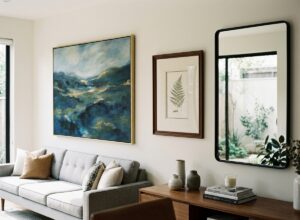
- Big pieces of art look more impressive than a collection of smaller ones. If you’re going to spend the money on a single piece, make sure it’s a large one. It’ll look better hung over a sofa or bed than a group of tiny paintings would.
- A nice frame can make all the difference. A small print in a nicely framed mat can look bigger and better than a huge work of art in a cheap frame. The mat also makes the piece look bigger by surrounding it.
- Mirrors aren’t exactly artwork; they’re more for reflecting light and making the room look bigger. They should be placed so that they pick up as much light as possible. Which means not placing them where they will reflect clutter.
Creative Wall Art Ideas Beyond Framed Prints
Framed pictures are the standard option, but they lack variety. To liven things up, combine different items.
- Gallery walls. Group similar colors, frames, or subjects. These styles provide more flexibility in a room with different sizes. But need more planning. Gallery walls can sometimes make a small room look cluttered.
- Picture ledges and floating shelves. Picture ledges allow you to lean your art rather than hanging it up. This means changing pictures every few months won’t require new holes. Floating shelves, which are simple to install and particularly convenient if you’re a renter, are another option.
- Textiles and tapestries. Hanging woven wall decorations is an excellent way to help absorb some echo in an otherwise bare room, while also providing warmth to a modern space. Simply hang them from a wooden dowel or curtain rod so that they’ll lie flat against the wall.
- Three-dimensional objects. Hats and musical instruments, ceramic plates, carved wooden accents, or wall planters add sculptural objects. A single sculptural piece can serve as a framed picture.
- Painted shapes and murals. An arch, a half circle, or a painted rectangle, in a single color, is an easy way to jazz up a room. All you have to do is buy the paint and some masking tape. The benefit of this is that the design can be tested out first with painter’s tape and usually kept for a couple of days.
- Maps and architectural drawings. Drawings of places you’ve traveled to or blueprints of your house have more character than most reproductions.
Ideas by Room
Living Room
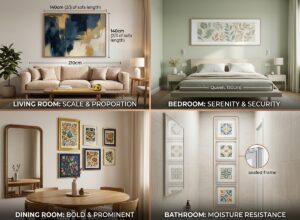
It is the place where the largest piece by far should be hung. It can be done above the sofa, from where the proportions of the picture will be clear. To do it right, take the length of the couch and choose the art that is 2/3 of that size, following the design industry standard. In addition, a set of frames may also be used if the wall is too long, but ensure that it is placed on the piece of furniture below.
Bedroom
The bedroom is not the place for dramatic compositions; instead, it is better to go for something plain and muted. Above the bed, the best option is to use a long horizontal frame or a set of them. Note that the heavy frames must be hung securely as they are placed high over the bed.
Dining Room
In the dining room, art must be more prominent and bold as people spend much time there. Big mirrors, still-life paintings, and gallery-style frames with botanical prints are all great options.
Kitchen
In the kitchen, the art must be resistant to humidity. That is why framed pieces of paper are the best option, as they can be wiped without damaging the paint. Additionally, it should be remembered that frames should not hang too close to the cooker.
Hallways and Stairs
Long, narrow walls are perfect for a set of paintings hung vertically. But on the stairs, the frames should be placed according to the direction of the steps and not vertically. As for the small space, it is better to create a composition using the same frames.
Bathroom
Since the bathroom is a humid room, the pictures there should be protected from moisture. Therefore, it is better to avoid canvas prints and wooden frames and choose the ones with glass and sealed options instead.
Home Office
The frames in the office must be selected with consideration of the time spent looking at them. Therefore, it is better to choose something less aggressive and calmer. But if the person working there often communicates via video calls, the art behind them should also be taken into consideration.
Choosing a Style Without Overthinking It
You do not need to commit to a named style. Instead, pick two or three constants and repeat them:
- A color that appears in every piece
- A frame finish used throughout
- A subject, such as landscapes, abstract forms, or portraits
Repetition makes different pieces feel related. Variety within that frame keeps it interesting.
Common Mistakes to Avoid
- Hanging too high. That’s the most common mistake. If you have to look up at your own work, it’s too high.
- Getting small items. One little frame on a huge wall is cheap, accidental, and doesn’t look good.
- Not taking light into account. The glare off glass and the yellowing of direct sunlight are both easy to avoid if you simply check the wall at different hours of the day.
- Matching everything. A room that has everything is boring. Let some items stand out from the rest.
- Over-crowding. Leaving some space in your otherwise empty wall is a good way to let everyone breathe.
- Using the wrong hardware. From plasterboard to brick, different walls need different support. Using the wrong hardware can lead to accidents involving falling glass.
- Buying art because it’s in style right now. Styles change. Buy what you know you’ll like in five years.
Final Thoughts
The best wall art ideas for homes is decorating the walls of the house rarely include the most expensive ones. A decently sized print in a nice frame, a painted archway, or several nice photos of your own making will have a far bigger impact than a premium purchase placed in the wrong spot.
Pick a single wall to begin with – measure it and experiment with sizing using paper cutouts before making any permanent changes. A house amasses personality over time, carefully picking and arranging its occupants. Decorate with items that you genuinely care for, and never overcrowd the space – the walls will find their own harmony given enough time.
Frequently Asked Questions(FAQs)
What is the best wall art ideas for homes?
A large statement piece above the sofa, or a gallery arrangement anchored to the furniture, works for most layouts. The best choice depends on your wall size and style.
How do I decorate a large empty wall on a budget?
Paint a shape or color block, hang a large piece of fabric, or create a gallery wall from thrifted frames and your own photos.
Can I hang wall art in a rental without damaging walls?
Many renters use adhesive hanging strips, leaning ledges, or floor-standing frames. Check your lease and the product’s weight rating, and test removal on an inconspicuous spot.
How many pieces should be in a gallery wall?
There is no fixed number. Start with five to seven for a standard sofa wall and expand if the space allows.
Should wall art match the furniture?
It should relate to the room, not match it exactly. Sharing one or two colors is usually enough.