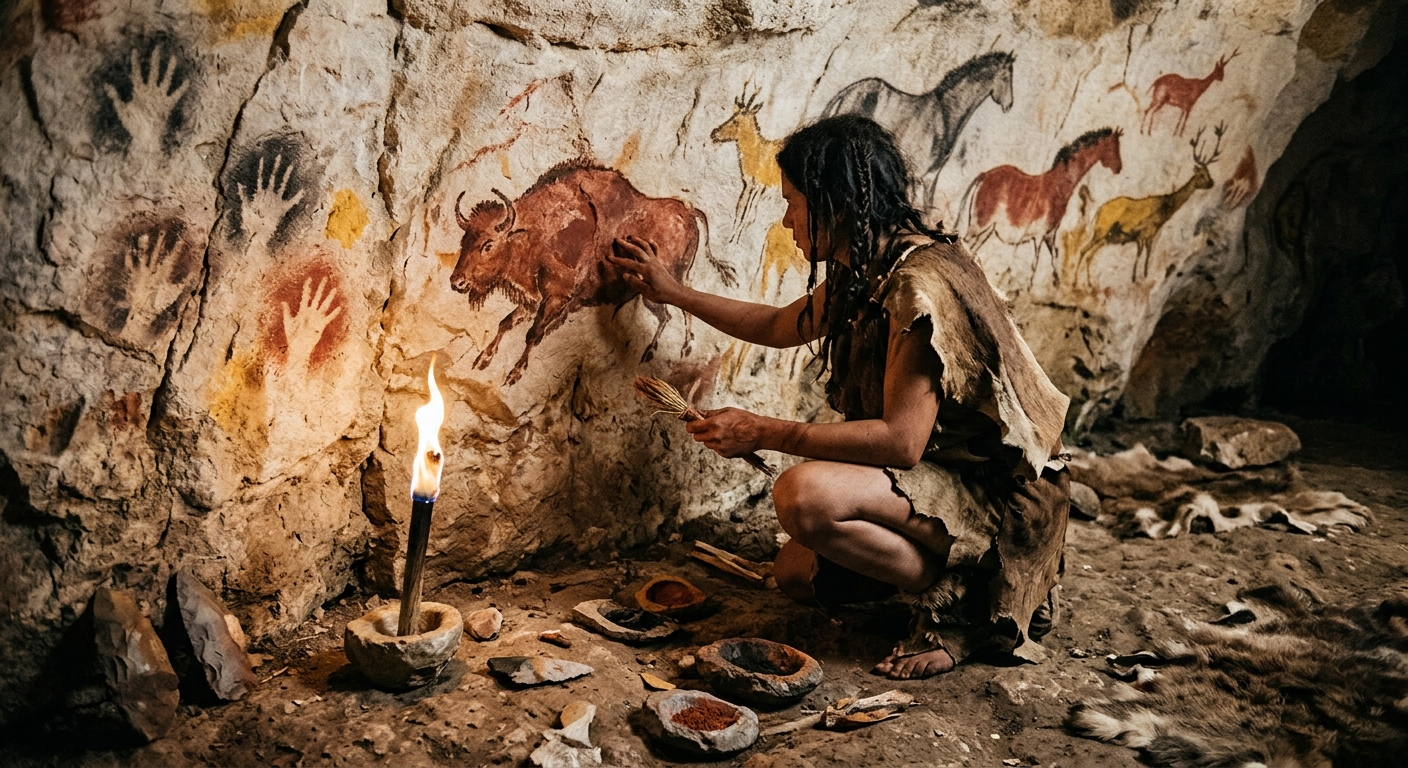
A Brief History of the Frist Visual Arts in Human Civilization
People searching for “frist visual arts” likely want to learn about either the first visual arts (primitive art), the first images people made, or Frist, a former Nashville gallery that became the frist visual arts. The names are very similar, and this article will describe both of these options.
First, I will briefly describe the history of the first visual arts, explaining how and why people started making images; then I will discuss art museums and galleries in Nashville, which can help people experience visual arts history in real life.
What Counts as “Visual Art” at the Beginning?
Today we think of art as something that is mounted in a gallery. This was not the case for most of human existence. The first visual art was probably something related to a person’s daily life, religion, and/or tribal markings. Things like etched stone, paint on skin, carved beads, and figures made from bone or ivory.
Researchers usually look for stylized, graphic, and symbolic signs. Something that goes beyond a necessary function. A sharpened spear is a tool. But the same spear with crosshatched markings is something more. It is the result of a person’s desire to communicate with others through a shared symbol.
The First Evidence of Human Art

Blombos Cave, South Africa
One of the oldest examples widely cited comes from Blombos Cave on the South African coast. In 2018, researchers described a small piece of silcrete stone with a crosshatched pattern, made with ochre and dated to about 73,000 years ago. The ochre is an iron oxide, which is a red or yellow pigment that is reasonably stable for thousands, if not tens of thousands, of years.
Due to the simplicity of the design, some researchers have questioned whether it should be considered art or some form of symbolic marking. An interesting point, but worth remembering that both early dates and interpretations were subject to revision. So, take any claims about the “oldest ever” with a grain of salt.
Cave art in Sulawesi, Indonesia
Cave paintings in Indonesia have also provided critical evidence of the dates. Multiple excavations have revealed images of various creatures, including wild pigs, with minimum ages estimated at more than 45,000 years. More recent findings even date the paintings to more than 50,000 years ago. This is significant because for a considerable time the European caves were considered the cradle of art.
The caves in Europe
However, even today, the European caves remain the most famous, the most visited, most studied, and the most extraordinary ones in terms of diversity of media:
Chauvet cave in France, with its charcoal and ochre paintings of lions, rhinos, horses, and bears, dated to about 30,000-36,000 years ago.
The Lascaux cave in Dordogne, Southwestern France, contains the most numerous and largest figures painted in red ochre. It was discovered by a farmer in 1940 and closed to the public in 1963 due to overcrowding and poor condition. Now a reconstructed version is available for visitors.
The Altamira cave in Spain has managed to survive until the present day with its polychrome bison paintings. Discovered by Don Marcelino in 1879, it was considered a forgery for decades because of the complexity of the artwork compared to the contemporaneous understanding of Stone Age people’s capabilities.
So, the Altamira discovery is another example of the underestimated achievements of ancient civilizations, which were later recognized as valuable and worthy of preservation.
Not Just Paintings: Sculpture, Beads, and Handprints
Visual art began in multiple ways beyond just painting.
- Handprints and stencils: People blew pigment over their hands onto walls in caves. They can be found on many continents and are one of the most personal artifacts left behind from the Ice Age.
- Carved figures: The Lion-Man of Hohlenstein-Stadel, Germany, a figure carved from mammoth ivory, is about 40,000 years old, while the Venus of Hohle Fels, Germany, is also ancient and is one of the oldest known sculptures.
- Beads and ornaments: shell beads and pendants show that body ornaments and possibly social groups existed very long ago.
Why Did Early Humans Make Art?
No one knows for sure; even the most objective historians will admit. There are a few different popular theories for the images found in caves, however,
ritualistic or spiritual practice as an important part of it,
- storytelling and instructive practices,
- some sort of social cohesion
simple expression are all very popular among scientists. It is very likely that many of these reasons overlap with each other, seeing as how different tribes lived in different conditions and might have had different reasoning for creating art.
From Cave Walls to Early Civilizations
As people transitioned to a more agrarian and urbanized society, the art produced became highly structured and integrated with power and religion.
- In Mesopotamia, Cylinder seals were incised and rolled onto clay as both a signature and a form of artistic expression. The Standard of Ur, dated back to approximately 2600 BCE, is a decorated panel made out of inlaid shell and stone that depicts tales of war and banquets.
- In Egypt, the art was highly conventionalized and utilized as a tool for religious and royal expression. The Narmer Palette, dated back to 3100 BCE, is considered by some researchers as one of the first examples of visual art being used as a medium to convey political power.
- In the Indus Valley, China, and the Americas, the tradition of seals, bronzes, and monumental sculptures, respectively, also flourished independently. Art and writing developed side by side, with some of the earliest examples of writing, the Egyptian hieroglyphs, being highly pictorial and thus almost indistinguishable from visual art.
Connecting This History to Nashville
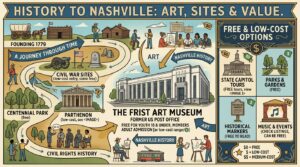
Unlike the famous caves of Chauvet or Sulawesi, a visitor to Nashville may not find himself facing an epic art experience in just the weekend. However, an art-history connoisseur might build a surprisingly vast array of exhibitions out of the institutions this town has to offer. Here’s how the art museums fit in.
The Frist Art Museum
The Frist Art Museum is located in a former post office building, converted in the 1930s into an Art Deco style. The Frist Center for the Visual Arts, as it used to be called since its opening in 2001, was later renamed to its current title. One of the first surprises that await first-time visitors is that the Frist does not possess a permanent collection. Mostly, the Frist offers changing exhibitions, often featuring pieces from abroad.
In other words, what you get to see there depends mostly on the timing of your visit. Some of the exhibitions may feature primitive or ancient art; others may have a contemporary focus. Before visiting, it may be a good idea to check out the website and see what’s on. A family with children still has options: at the Martin ArtQuest, they can explore their artistic talents, learning how to make images with real tools like our ancient ancestors.
Free and Low-Cost Options
Many readers search for free museums in Nashville, so here is a realistic overview. Policies and prices change, so verify on each official website before you go.
| Venue | What it offers | Cost note (verify before visiting) |
| Tennessee State Museum | Tennessee history, artifacts, and early Native American material | Has been free to the public; confirm current policy |
| Frist Art Museum | Rotating art exhibitions | Paid admission for most adults; discounts and free access for certain groups have been offered, so check |
| Fisk University Galleries | Historically significant collections tied to Fisk and the African American art tradition | Policies vary; confirm hours and cost |
| Cheekwood Estate and Gardens | Art, gardens, and a historic estate | Paid admission |
| The Parthenon in Centennial Park | Full-scale replica of the Athenian temple with an art collection | The park is free; the building has charged admission |
For readers interested in the earliest human story, the Tennessee State Museum is a particularly good fit. Its material on Tennessee’s long Native American history connects to the idea that every region developed its own visual traditions, from carved shell gorgets to pottery and engraved objects. Check which items are on display during your visit, since exhibits rotate.
Art Galleries in Nashville, TN
If you want to see contemporary art, not ancient artifacts, Nashville has no shortage of galleries. Dotted around the downtown area, The Arcade, Wedgewood-Houston, and other commercial galleries offer a range of exhibits. Many commercial galleries are free to visit, albeit with limited hours (and some only by appointment). Do some research on what’s out there rather than relying on old guides, since galleries tend to open and close throughout the year.
A trip to these galleries is a great way to see the continuity between ancient and modern art, as both use pigment, form, and symbolism to communicate meaning to their audience.
A Simple One-Day Plan
- Morning: Visit the Tennessee State Museum for regional history and early material culture.
- Midday: Walk downtown for lunch.
- Afternoon: See whatever is currently showing at the Frist Art Museum.
- Late afternoon: Browse a few galleries in The Arcade or another gallery district.
This plan keeps travel short and lets you compare historical and contemporary art in a single day. Keep it flexible, since exhibitions and hours vary.
Read More: 15 Romantic Art Date Night Ideas to Make Every Moment Special
Common Mistakes to Avoid
- Assuming the Frist has a permanent collection. It does not, so check the current exhibitions first.
- Treating “oldest art” claims as settled. Dating methods improve, and records get broken.
- Relying on old pricing or hours. Museum policies change often.
- Trying to see too much. One museum and one gallery visit is more rewarding than rushing through four.
- Skipping the context. Reading the wall text or taking a guided tour dramatically improves what you take away.
Key Takeaways
- For many years before the development of civilizations and the creation of writing systems, people made symbolic images.
- There are numerous varieties of ancient art, such as painting, carving, beads, and handprints.
- The main hypotheses about the origin of art are still controversial, despite attempts by various encyclopedias to describe it.
- Thus, the easiest way to comprehend information about different eras and cultures is to visit one of the Nashville galleries or museums. But note that the exhibits and their costs may vary, so it is better to check the up-to-date information about them.
Frequently Asked Questions (FAQs)
What is the oldest known visual art?
It depends on what you consider visual art. Ochre engravings from Blombos Cave have been found to originate roughly at the same time period as the 73,000-year mark, while the figurative cave paintings found in Indonesia have been dated to a period of more than 45,000 years ago. Discoveries may push the dates further.
Is the Frist Art Museum the same thing as the Frist Center for the Visual Arts?
Yes. The Frist Center for the Visual Arts used to be called the Frist Art Museum until it opened its new location under the new name.
Does the Frist showcase ancient cave art?
No, not cave art, as the Frist does not host any permanent exhibitions, only special exhibitions that change with time. You will need to check their website for information regarding the temporary exhibitions that the Frist has to offer.
Are there any museums in Nashville that are free to visit?
There are, but the list is shorter than one might actually think, as the policies tend to change. One such example that has been popular for a considerable time among those who like museums is the Tennessee State Museum. It is a good idea to double-check any information before heading to the museum.