Halloween in Art: Famous Paintings and Dark Artistic Themes
While most people associate Halloween with orange pumpkins and cartoon ghosts, artists have created pieces that reflect the holiday’s true essence: fear, death, the supernatural, and the fine line between normality and strangeness.
In this article, we will look into Halloween in art. First, we will look at popular paintings that capture the Halloween vibe, even if they weren’t intended to be Halloween-related. Secondly, we will look at the common themes that are present throughout. Lastly, we will look into the practical side by examining how old Halloween artwork was created, and how you can create your own Halloween painting or piece of art at home, in the classroom, or with friends!
Where Halloween and Art Actually Meet
To begin with, there aren’t many great artworks depicting Halloween. While celebrating Halloween has evolved from the Celts’ celebration of “Samhain” and Christians’ celebration of “All Hallows’ Eve”, it became popular in its modern form largely in the USA throughout the late 19th/20th century. Great artwork does not often depict this holiday.
However, throughout history there has been an abundance of artwork depicting these themes. Death, witchcraft, nightmares, monsters, and the afterlife have been key themes throughout European artwork long before plastic skeletons appeared. When referring to artwork depicting Halloween, we’re usually talking about the historical spooky theme, along with illustrations and folklore.
This can help you decide on what to look at or recreate. Some artwork will be Halloween-themed due to association; others will be Halloween-themed due to their content, while a few may be both.
Famous Paintings That Carry the Halloween Mood
Francisco Goya: Witches, Owls and Sleeping Minds
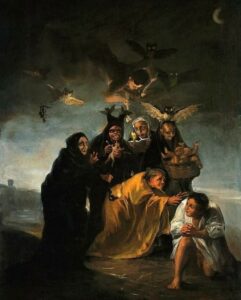
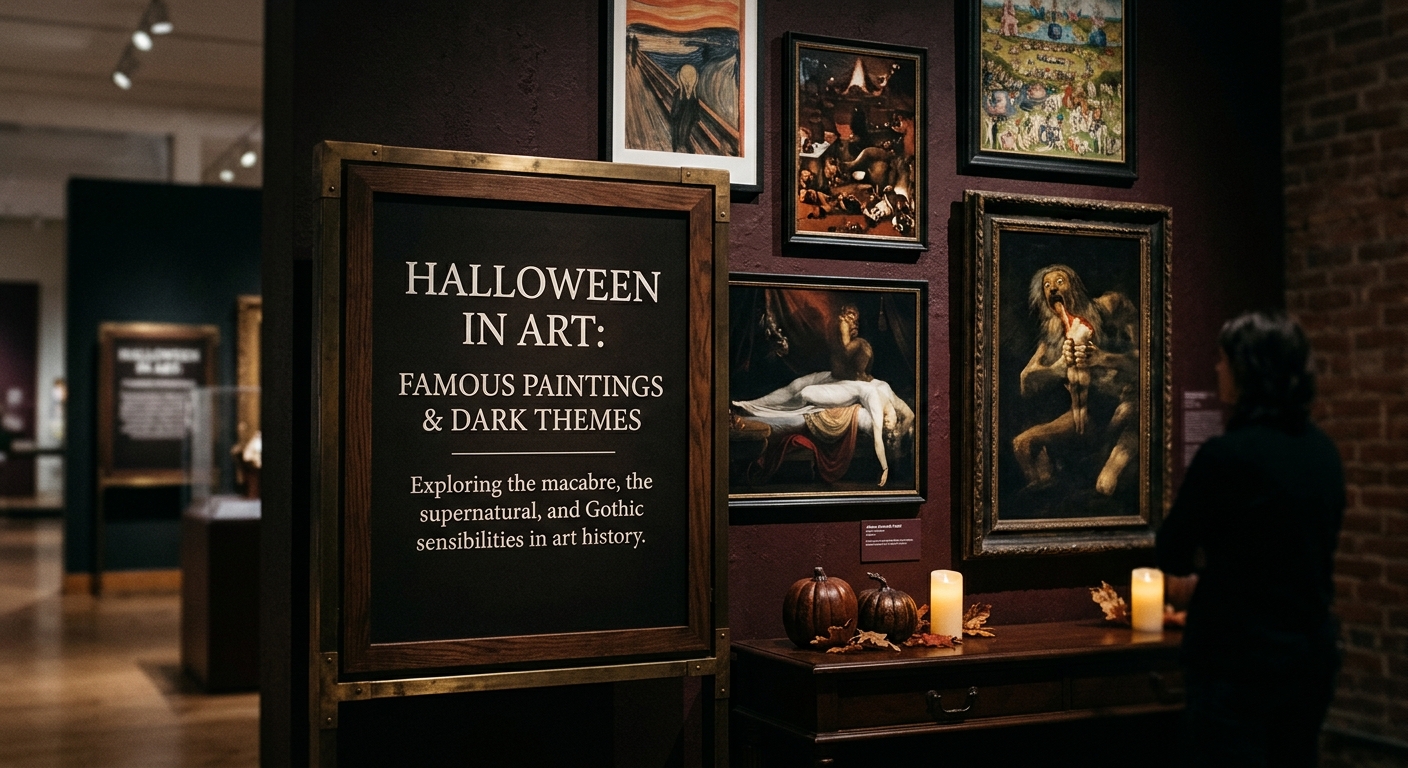
Goya is probably the most helpful of the artists with dark themes. In ‘The Sleep of Reason Produces Monsters’, part of his series ‘Los Caprichos’ (1799), a man is slumped at a desk, with bats and owls flying all around him. Whilst this looks like a Halloween poster, Goya was trying to make a comment on superstition.
Witches’ Sabbath (The Great He-Goat) features a large group of pale, hunched individuals surrounding a massive goat. The lack of colour is a large part of what makes this painting feel eerie. Goya used mainly dark brown, grey, and sickly yellow.
Towards the end of his life, he painted some intense and disturbing works known as the ‘Black Paintings’. One of these is ‘Saturn Devouring His Son’. This would be better suited for older viewers due to the intensity.
Henry Fuseli: The Nightmare

‘The Nightmare’ (1781) by Fuseli features a sleeping woman laid across her bed. A small crawling creature sits on her chest, and a ghostly horse’s head peeks through the curtains. This painting was a huge hit when first displayed, and there are a few versions of it.
This painting is a great example to look at due to the lighting. The brightest part of the painting is the pale body of the sleeping woman. Everything else fades to shadows. This is a great effect to use to create a focal point in your paintings.
Hieronymus Bosch and Pieter Bruegel: Hell and Death on a Crowded Canvas
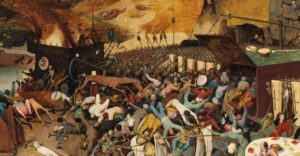
‘The Garden of Earthly Delights’ by Bosch (around 1490-1510) ends with the right side of the painting being very eerie. There is lots of fire and odd mixed creatures. ‘The Triumph of Death’ (around 1562-1563) by Bruegel the Elder is even more intense. Skeletons sweep across the ruined landscape and kill everyone regardless of class.
Both paintings have a lot going on, which many Halloween images today lack. Every corner has something new to discover. If you want to create a Halloween painting that looks good on second glance, include lots of little details.
Hans Holbein: The Skull Hidden in Plain Sight

‘The Ambassadors’ (1533) by Holbein features a smudged object at the bottom of the painting. When viewed from the side, you can see it is actually a skull. This is an example of anamorphosis. Holbein was subtly reminding the viewer that wealth and status will end in death. Holbein also designed a famous series of woodcuts titled ‘Dance of Death’. Skeletons accompany kings, traders and children.
Arnold Böcklin and Edvard Munch: Atmosphere Over Monsters
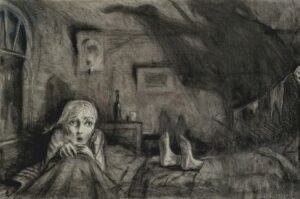
Not all dark paintings need creatures. ‘Isle of the Dead’ by Böcklin (multiple versions 1880-1886) features a small boat heading towards an island of rocks covered in cypress trees. There isn’t any violence, but the atmosphere is heavy and odd.
‘The Scream’ (1893) by Munch also has this effect. There aren’t any ghosts or demons, but the swirling sky and the expression on the figure are terrifying. These are a great reminder that atmosphere can be more important than the subject.
Daniel Maclise: Snap-Apple Night
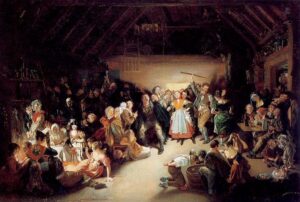
If you want a literal Halloween painting, then ‘Snap-Apple Night’ (1833) by Maclise is perfect. This painting shows a lively Halloween party in Ireland. There are games, music, flirting, and divination. This is a rare historical painting showing how Halloween was actually celebrated. This is much more upbeat than the previous works.
Dark Themes Artists Keep Coming Back To
The same handful of subjects appear again and again across centuries. This table is a quick way to spot them.
| Theme | Classic example | What to look for |
| Death and mortality | Bruegel, The Triumph of Death | Skeletons, crowds, ruined landscapes |
| Vanitas (life is short) | Dutch still lifes of the 17th century | Skulls, hourglasses, wilting flowers, snuffed candles |
| Nightmares and the unconscious | Fuseli, The Nightmare | A single bright figure, heavy shadow |
| Witchcraft and superstition | Goya, Witches’ Sabbath | Muted palette, crowded and distorted faces |
| Hell and punishment | Bosch, Garden of Earthly Delights | Hybrid creatures, fire, tiny repeated details |
| Celebration of the dead | Posada, La Calavera Catrina | Elegant skeletons, humor mixed with mortality |
Just a quick note on the last row. Día de Muertos (Day of the Dead) is another tradition practiced in Mexico. The image of a female skeleton by José Guadalupe Posada from the early 20th century is an affectionate and humorous take on death, and was made famous by Diego Rivera in his mural Dream of a Sunday Afternoon in Alameda Central. It is an interesting point to mention here as it demonstrates how differently the culture views this topic.
Vintage Halloween Artwork: Postcards, Paper and Pumpkins
There is a rich visual culture surrounding this holiday. From around the beginning of the 1900s to the 1920s, there is very collectible vintage Halloween in art.
- Postcards: There was great popularity for postcards with Halloween images. Many were produced in Germany. Ellen H. Clapsaddle is a common artist associated with this time. The images generally feature children with Jack-O-Lanterns, black cats, witches on brooms, and divination games.
- Cut-outs: Cardboard items with cut-out shapes were produced by companies such as Beistle Company in the beginning of the 20th century. These often included pumpkins, owls, and skeletons.
- Party books: Dennison, a company that produced crepe paper, created books to help people create decorations for their parties. They also advised on costumes.
There is lots to take note of visually. The colours are generally warm oranges, yellows, and blacks. Often the faces on the pumpkins and moons are human-like. Many images will show young people playing divination games, reflecting how Halloween was originally a time for romance and divination.
When collecting or purchasing any vintage items, always check who made it, when, and what printing technique was used. To do this, go to a reputable dealer or auction house. There are lots of replicas, so prices vary.
Halloween Art Ideas and Activities You Can Actually Do
Here are some art projects divided into how long they take to do and how much they cost.
Fast and cheap
- Create a scene with a background using watercolour paper and create an orange and purple gradient sky. Add some cut-out black trees and maybe a house and/or cat. This project can be done at any age and is very forgiving.
- Create a vintage postcard. Choose an old design (such as a black cat or jack-o’-lantern) and draw it out using a restricted 3-colour palette. Add in some vintage text.
- Create a calavera. Inspired by Posada, create a skeleton character wearing an elegant hat. Make sure to mention that this is inspired by Day of the Dead and not Halloween.
Moderate difficulty
- Vanitas. Use a small pumpkin, candle, pocket watch, and some dried leaves. Draw or paint them using just a lamp. This will help teach you to observe and use light.
- Nightmare inspired by Goya. Draw a sleeping character and fill their dark background with owls, bats, and obscure figures. Using a scratch foam plate will give a textured etching effect.
High difficulty
- Miniature world inspired by Bosch. Split a large piece of paper into sections and create your own creature or scene in each section. Great for group work in a classroom or family.
- Distorted skull. Try creating a distorted image. This will need some patience and graph paper. Great for teens and adults.
How to Make a Halloween in Art That Works
- For an effective Halloween art painting, it is better to make use of light and restraint. Here are some tips that can be seen from the paintings below.
- Paint onto a dark background. This will help to create a dramatic effect. If you start by painting a medium-dark colour such as a deep brown or blue grey, then you will have more control over where you add the lighter parts.
- Restrict the colours you use. Goya and Böcklin used a few dull shades to create the atmosphere they wanted. Pick 1-2 dark shades such as black, an orange, a grey, and an accent.
- Choose a light source. This could be a candle, moon, or window, and decide where you are going to place this.
- Creating depth. Use glazing by adding thin translucent layers of darker paint onto dry paint. This will create a gentle smoky effect.
- Suggesting rather than showing. Often it is more effective to suggest something like a shape in the doorway or two eyes in a dark area than to show a full monster.
Common mistakes to avoid:
- Using pure black straight from the tube everywhere. Mixing a dark from blue and brown gives richer shadows.
- Lighting the whole scene evenly, which removes the tension.
- Adding too many symbols at once. Pumpkin, bat, ghost, witch, and cat in one small space tends to look cluttered.
- Treating Day of the Dead imagery as generic Halloween decoration. If you use it, credit the tradition.
Final Thoughts
The theme of Halloween can be seen in many artworks. From the overcrowded hells of Bosch to the lone sleeping figure of Fuseli, and Posada’s grinning skeletons to the orange and black postcards of the early 1900s. By examining the techniques used in lighting, colour schemes, and suggestion, you will find lots of inspiration to use in your own work.
Frequently Asked Questions
Are there famous paintings about Halloween itself?
A few, such as Daniel Maclise’s Snap-Apple Night, but they are the exception. Most “Halloween” art is really older art about death, witchcraft, and the supernatural.
What is the scariest famous painting?
That is subjective. Goya’s Black Paintings and Bosch’s hell panel are often cited, but Fuseli’s The Nightmare and Munch’s The Scream unsettle many viewers more because they rely on atmosphere.
What is a good first Halloween painting for a beginner?
A silhouette scene against a sunset sky. It requires no drawing skill and looks impressive.
Is vintage Halloween artwork valuable?
Some pieces are, but values depend on condition, maker, rarity, and demand, so check current auction results or a qualified appraiser rather than relying on a guess.