What Is Art? A Simple Guide to Understanding Art
Ask ten people “what is art?” and you will likely get ten different answers. One person points to an artwork in a museum. For another, art is music or a movie. One may think of a hand-made quilt her grandmother made. Another person claims that art is something that makes them feel a certain way.
They are all correct, which is why this question is simultaneously easy to answer and impossible to settle once and for all. This guide will provide a working definition of art, explain why the discussion surrounding it is eternal, list examples of visual arts, describe the concept of art therapy, and explain what an art therapist is.
What Is Art? A Short Answer
Art is something that people make to express some idea, emotion, or experience, or to create something meaningful or beautiful, and to share it with others.
This definition has three parts that are worth pointing out:
- It is made by people. A sunset, for instance, can be beautiful, but it is not art, because it is made by nature. However, the photograph of this sunset, which is made by a person, may be art if someone makes a conscious effort to create it.
- It is made with intention. This means that the art is created with certain decisions on its form; the creator chooses certain colors, words, symbols, or other elements to put it together.
- It is made to be an experience. Even the sketches that are drawn in a private journal are art, once someone looks at them and interprets them in any way.
This is a working definition of art, because the concept itself has been debated for centuries, and there are various views and arguments regarding it, which I am going to discuss further.
What Is the Meaning of Art?

When people wonder about the meaning of art, most often they have in mind two questions: the etymology of the word art and the definition of art itself.
The etymology of the word art
The word art in English has its Latin predecessor, namely, ars. This word was used to refer to any skill or craft. These skills were considered to be of a very broad category, ranging from such things as furniture-making to poetry. However, with time, the concept of art in the modern sense of the word appeared in Europe in the eighteenth century. By that time, in earlier cultures, there was not such a distinction, so various types of crafts were not separated from each other. A beautifully made piece of furniture, a woven pattern on fabric or mats, and a fine painting were all considered to be the products of skillful and meaningful work.
What art is for
Art has never been singular in its function. Throughout history and different civilizations, art has fulfilled multiple roles:
- A means of communication of ideas and feelings that are non-verbal or challenging to express;
- A medium to document, record, and keep memory, such as Zainul Abedin’s sketches of the Bengal famine of 1943, which live as a testament to that event;
- Means of expression of religious belief or communal traditions, like temple sculptures or ritual garments;
- Art as aesthetic enhancement and pleasure;
- Protest, dissent, and questioning of the status quo;
- Art as personal exploration and means of delving into one’s soul.
In my opinion, art’s definition depends on the context in which it is created and perceived, the mediums of its expression, its historical timeframe, and the individuals involved in perceiving it. One artifact can have different meanings to different people, depending on their background, education, experiences, location, and even the environment in which they view the art piece. Gallery versus museum versus home versus a natural habitat all influence the message one perceives in an artifact.
Why Is Art So Hard to Define?
Because every neat definition has been broken by an artwork that does not fit it. Here are the main attempts, and where each one struggles.
| Idea | Core claim | Where it struggles |
| Art as imitation | Art copies reality well | Abstract art does not copy anything |
| Art as expression | Art communicates the maker’s feelings | A maker can feel deeply and still produce something dull, and a viewer may feel something the maker never intended |
| Art as form | Art is about how lines, colors, and shapes work together | It ignores context and meaning |
| Art as an institution | Art is what the art world (artists, museums, critics) accepts as art | It feels circular and leaves out art made outside those circles |
The most infamous example of this is Marcel Duchamp’s Fountain (1917): a standard-issue porcelain urinal signed R. Mutt. This was not a skillfully made object, and it did not depict anything. It challenged the very idea that art was about skill and representation. It raised the possibility that the artist’s idea and choice were part of what made art what it was. A century later, people are still arguing about it. Perhaps that is the right answer.
A practical approach to defining art
If you are looking for a more pragmatic approach, ask yourself these questions when confronted with an unfamiliar work or artistic medium. If the answer to any of these is “yes,” then chances are you are looking at art.
- Was it made or selected by someone with a particular message in mind?
- Does it communicate that message?
- Does it attract attention?
- Does it display skillful execution or unique perspective?
- Is it regarded as something special by a relevant audience?
A positive answer to any of these questions is enough to warrant considering something art. You don’t need all of them to be “yes” – in fact, it is normal for some of them to be “no.”
Art vs Craft vs Design
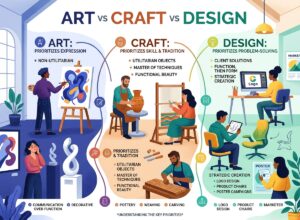
These three terms have overlapping areas and the lines between them are blurred, but there are usually several differences that distinguish them:
- Art prioritizes expression or communication. It can be decorative or non-utilitarian, and its function, if any, is subordinate to its communicative or expressive role.
- Craft prioritizes skill and often takes the form of utilitarian objects. Pottery, weaving, and carving are examples of crafts.
- Design prioritizes solving a particular problem for a particular client: creating a logo, a chair, or a poster, for example.
Of course, many works fall into several categories at once. One example is the traditional embroidered Bengali Kantha quilt, which is at the same time a piece of folk art, a craft (making useful items), and an expression of tradition.
Visual Arts Examples
Visual arts are the forms you experience mainly with your eyes. Here are the main categories, with examples you can look up.
| Type | What it is | Examples to explore |
| Painting | Pigment applied to a surface | Leonardo da Vinci’s Mona Lisa, Picasso’s Guernica |
| Drawing | Marks made with pencil, ink, charcoal, or chalk | Zainul Abedin’s famine sketches |
| Printmaking | Images transferred from a prepared surface | Hokusai’s The Great Wave off Kanagawa (woodblock print) |
| Sculpture | Three-dimensional work in stone, metal, clay, wood, and more | Rodin’s The Thinker |
| Photography | Images made with a camera, by light | Ansel Adams’ landscapes |
| Ceramics | Objects shaped and fired from clay | Handmade pottery and glazed tiles |
| Textiles | Work made from fiber, thread, or fabric | Nakshi Kantha quilts, woven tapestries |
| Digital art | Work made or shown with software and screens | Illustration, 3D modeling, generative art |
| Installation | Art that transforms a whole space | Yayoi Kusama’s mirrored “Infinity Mirror Rooms” |
| Street art | Work made in public spaces | Murals and stencil art |
| Vernacular and folk art | Traditional art made within community culture | Decorated rickshaw art in Dhaka |
Architecture, film, and video are also commonly included in the wider category of visual arts. Music, dance, theater, and literature belong to the category of performing and literary arts, which are expressed through sound and performance, rather than a visual medium.
As one can see, the more we look into one category, the more it branches out. Take painting, for example, which includes such varied traditions as Persian miniatures, abstract expressionism, and many other forms that have developed throughout hundreds of years. It is therefore useful to narrow the focus and try to get to know a particular branch of the art which attracts you personally.
What Is Art Therapy?
Art therapy is a psychological therapy that uses art production as a treatment method. One works with a qualified professional and uses drawings, painting, modeling with plasticine or clay, collage, or other media to investigate and understand emotions, particularly those that cannot be easily verbalized.
The key is that art therapy is not an art class where the goal is to create a nice picture without specific intention. In the art therapy session, the image itself, its meaning, and the client’s associations with it are more important than the result. What the client will notice during the creation process and what the therapist will discuss with him after he finishes the picture are also significant aspects.
A person may be referred to art therapy or may seek it out for various reasons: overcoming grief and trauma, coping with stress, anxiety, depression, and other challenges. The effectiveness of art therapy for different mental problems has been proven statistically, but since results differ from case to case, therapies may not be applicable for everyone. Still, if you have some psychological issues, consult a professional psychiatrist or psychologist; they will prescribe the right type of therapy.
Art therapy versus art-making for wellbeing
The two types of activities may seem similar, but they have essential differences:
- Art-making for wellbeing is a hobby and may be performed both individually, for example, sketching in the evening or on a weekend, or in a group. It usually has no goal except for creating something pretty and calming, like painting landscapes or joining a community pottery class.
- Art therapy is a form of treatment and requires professional training.
What Is an Art Therapist?
An art therapist is a trained mental health professional who uses art-making within therapy. Their work combines understanding of psychology and therapeutic practice with knowledge of art materials and creative processes.
In practice, an art therapist typically:
- Invites the client to make something, with guidance but no pressure to be “good” at art
- Pays attention to the process as well as the finished piece, such as what the person chose, avoided, or changed
- Encourages the client to reflect on and talk about their own work, without imposing a fixed reading on it
- Adapts the approach for the person, whether a child, a teenager, an adult, or an older person, and for individual or group sessions
A point worth knowing: a good art therapist does not “decode” your drawing like a puzzle with a hidden answer. The meaning comes mainly from your own reflection on the work.
How to find a qualified art therapist
Training and legal requirements for art therapists vary from country to country. In many places, art therapists finish their postgraduate training and get registered with a professional body. However, titles and regulations can differ. Before getting into any form of art therapy, it is vital to note the following:
- Confirm that art therapy is a regulated profession in your country.
- Get clarification on the therapist’s qualifications and registration.
- Ensure that they work under a professional code of ethics.
It might be necessary to check with your country or locality’s professional registration organization because requirements may change.
Common Mistakes When Thinking About Art
- Believing art has to be beautiful. A lot of powerful art is ugly, unpleasant, or boring.
- Believing that art is an expression of skill. The ability to create art is a huge plus, but it does not necessarily come with a guarantee of value.
- Believing that art should be accessible; that anyone who wants to can make art. Well, maybe your work is amazing. It may be perfect, but what makes it valuable is the vision, the time, and the context in which it was created.
- Asking that art demonstrate its value. The cost of the piece is subjective, based on things that may or may not have anything to do with the work itself.
- Thinking that there is only one possible meaning to any particular piece. An artist always has intent behind their work, but the value of the work comes from the mixture of personal intent and the audience’s interpretation.
- Treat art therapy like an art class. Therapy is not meant to produce work for the benefit of others.
Key Takeaways
- Art is the product of human creativity that is intended to impress, deliver, or reflect a particular idea.
- The definition of art and its criteria may change depending on the culture, time period, and the person whose opinion you are asking, which is why there is no standard definition.
- There are various categories of art, including painting, graphics, sculpture, photography, ceramics, textile, computer software, digital media, installation, folk art, and many others.
- Art therapy, however, is a form of treatment created and practiced by specialists, and an art therapist is a qualified professional who uses art therapy to help patients.
- To understand art, you do not have to be an expert in the field. All you need is a little time and a sincere look at the work presented.
Frequently Asked Questions(FAQs)
Is everything art?
It is debatable, since most definitions of art include the criterion that some intention is needed to create or present it as art.
Does art have to be made by hand?
No, since photography or computer-designed art uses other means to present it. Yet, the intention and skill necessary to do that still come from a person.
Can anyone be an artist?
Yes, because artistic skills can be honed to a high standard through practice. Anyone can practice, even if their natural talent is low.
Do you have to be good at art to do art therapy?
No, since such therapy focuses on process rather than product. This means it is not necessary to strive for high quality in artistic works during therapy.